Asia Pacific is projected to hold the largest warehousing and storage market share of over 54․5% in 2025.
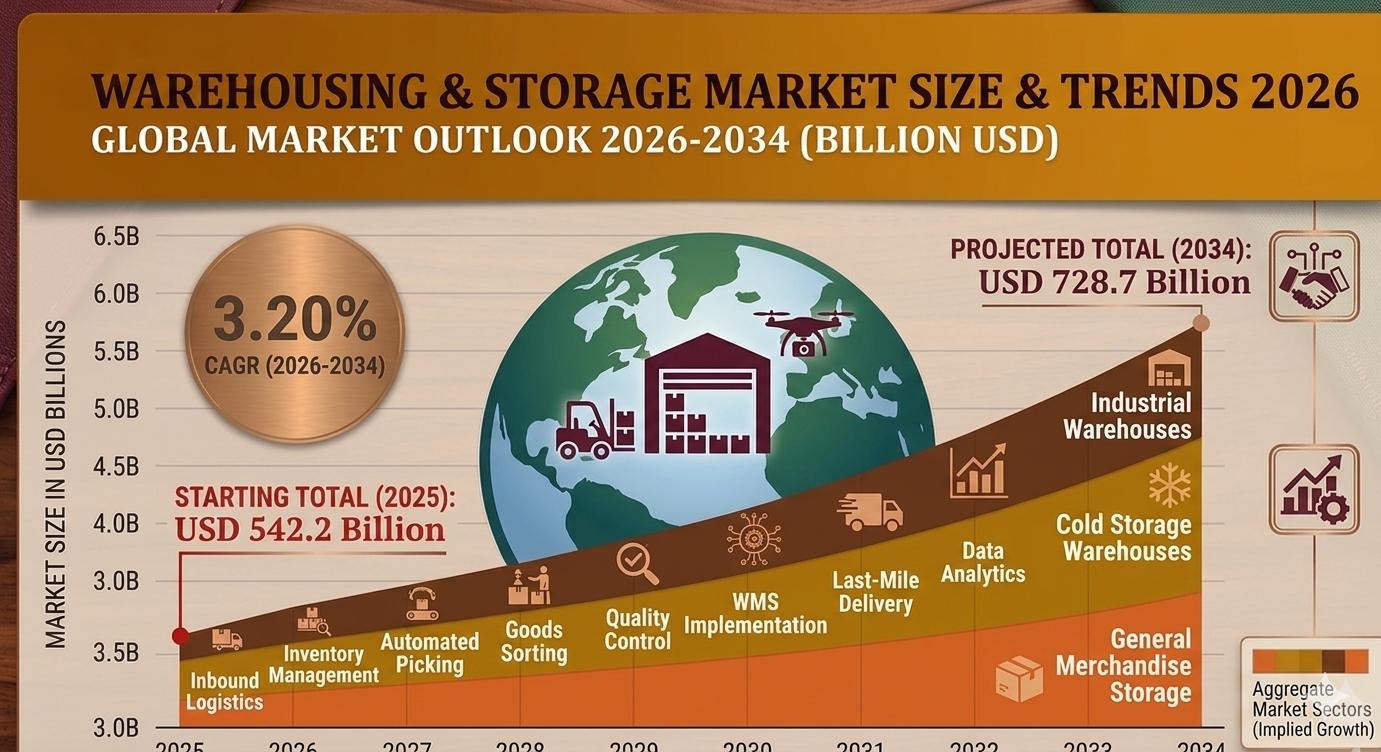
ST. BROOKLYN, NY, UNITED STATES, April 15, 2026 /EINPresswire.com/ — According to a research report by IMARC Group, the global warehousing and storage market size was valued at USD 542.2 Billion in 2025. The market is projected to reach USD 728.7 Billion by 2034, exhibiting a growth rate (CAGR) of 3.20% during 2026–2034. Asia-Pacific currently dominates the market, holding a significant market share of over 54.5% in 2025. The market is primarily driven by e-commerce expansion, supply chain optimization, third-party logistics (3PL) growth, cold storage demand, and technological advancements including automation and smart warehousing.
Key Highlights of the Warehousing and Storage Market Report:
• The global Warehousing and Storage Market was valued at USD 542.2 Billion in 2025 and is projected to reach USD 728.7 Billion by 2034, registering a CAGR of 3.20% during the forecast period (2026–2034), according to IMARC Group.
• Asia-Pacific dominates the global warehousing and storage market in 2025, holding over 54.5% of the market share, driven by rapid manufacturing expansion, booming e-commerce, rising urbanization, and increasing investments in logistics infrastructure.
• North America represents a significant regional market led by the United States, which accounts for over 89.80% of North American market share, supported by growing e-commerce demand, same-day delivery requirements, cold storage expansion, and advanced 3PL adoption.
• By type of warehouses, general warehousing and storage holds the largest segment at around 69.3% of the market, owing to its versatility and high demand across retail, manufacturing, and e-commerce sectors.
• By ownership, private warehouses lead the market with around 65.4% of the market share in 2025, preferred by large enterprises for operational control, faster order fulfillment, and tailored logistics solutions.
• By end-use, manufacturing leads with around 18.2% of the market share, driven by demand from automotive, electronics, pharmaceuticals, and FMCG sectors requiring efficient raw material and finished goods storage.
• Key market drivers include e-commerce growth, same-day delivery trends, and rising demand for cold storage in food, pharmaceutical, and biotech industries, alongside increasing adoption of automation and smart warehousing technologies.
• Key market trends include the integration of autonomous mobile robots (AMRs), AI-driven inventory management, cloud-based warehouse management systems (WMS), and expansion of green and energy-efficient warehousing solutions.
• Major market challenges include high capital investment requirements for automation, labor shortages, real estate constraints in urban areas, and the complexity of managing multi-tier global supply chains amid economic uncertainty.
• Leading players profiled in the report include Central Warehousing Corporation (CWC), CEVA Logistics, Deutsche Post AG, DSV A/S, FedEx, Geodis Group, Nippon Express Holdings, Inc., RXO Inc., Ryder System, Inc., and XPO, Inc.
Request for a Sample Report for Detailed Evaluation: https://www.imarcgroup.com/warehousing-and-storage-market/requestsample
What Is Driving Warehousing and Storage Market Growth in 2026?
Supply Chain Optimization and Third-Party Logistics (3PL) Expansion:
Companies use warehouses for storage close to transport networks and urban areas and ports‚ reducing transport time and cost․ The rise of third-party logistics providers (3PL) allows companies to outsource all storage‚ distribution‚ and order fulfillment costs in an affordable‚ flexible model‚ backed by new information technologies․ Along with the globalization trend‚ growing volumes of cross-border logistics have increased the need for warehousing as part of the supply chain․ Companies are investing in distribution centers to prevent stock shortages‚ maintain business continuity‚ and better manage warehouse inventory in relation to changing customer demand levels․ Additionally‚ US-based Panattoni will invest Rs 110 crore to set up a warehouse park in Delhi-NCR‚ its first project under construction in India as of December 2023‚ by March 2025․
Technological Advancements and Smart Warehousing:
Warehousing automation technologies‚ like automation‚ robotics‚ IoT‚ and artificial intelligence (AI)‚ have been developed to maximize warehouse space and efficiency through technologies like AS/RS‚ AMR‚ machine learning‚ and AI technologies like machine learning‚ while enabling automated storage and retrieval systems‚ autonomous mobile robots‚ and machine learning processes to reduce labor costs and errors․ Real-time analytics‚ machine learning‚ and predictive inventory technologies can increasingly control the efficient use of a warehouse and be integrated with a cloud-based WMS to provide supply chain visibility․ In February 2025‚ inventory intelligence platform Gather AI announced it was adding new US-manufactured Starling 2 Logis drones with ModalAI’s VOXL 2 autopilot platform for warehouse inventory taking‚ starting in Q2 2025․
Cold Storage Expansion and Industry-Specific Demand:
Demand for temperature-controlled warehouses is increasing to accommodate perishable foodstuffs‚ pharmaceuticals‚ and biotechnology products․ The online grocery business‚ frozen foods‚ and vaccines are growing․ The cold chain logistics market benefits from this trend in supply chain management․ There are warehouses built to industry standards‚ like automotive‚ electronics‚ and chemicals․ In July 2024‚ Walmart opened a new 730‚000 square feet (68‚000 m2) perishable distribution center in Lancaster‚ Texas․ This center distributes fresh produce‚ dairy‚ eggs‚ flowers and frozen products to Walmart stores in the area․
Explore detailed insights, industry trends, and future outlook of the warehousing and storage market: https://www.imarcgroup.com/warehousing-and-storage-market
Warehousing and Storage Market Segmentation Analysis:
By Type of Warehouses
• General Warehousing and Storage
• Refrigerated Warehousing and Storage
• Farm Product Warehousing and Storage
General warehousing/storage is the largest segment of the warehousing market‚ accounting for 69․3% of total revenues in 2025․ Demand for general warehousing is driven by its flexibility and lower costs which lead to meaningful requirements from various end-user industries․ General warehousing/storage provides storage for an abundance of items‚ such as industrial machinery and equipment‚ consumer goods‚ raw materials‚ etc․ As a result of e-commerce and an increasingly global supply chain‚ general warehouses offer the ability to store goods with flexible durations‚ inventory levels‚ and storage space to companies requiring variable amounts of storage․
By Ownership
• Private Warehouses
• Public Warehouses
• Bonded Warehouses
Private warehouses held the largest segment of the global market‚ with a share of approximately 65․4% in 2025․ This was largely due to their ownership‚ cost-effectiveness‚ and adaptability to specific needs․ Various sectors‚ including retail‚ manufacturing‚ and e-commerce‚ preferred private warehouses for inventory management‚ order fulfillment‚ and supply chain optimization․ These warehouses often utilize advanced storage technologies‚ automation‚ and logistics solutions to improve efficiency and reduce costs․
By End-Use
• Manufacturing
• Consumer Goods
• Retail
• Food and Beverage
• IT Hardware
• Healthcare
• Chemicals
• Others
Manufacturing holds the largest share of the logistics market‚ at approximately 18․2% of the total market in 2025․ The manufacturing sector utilizes a considerable amount of space for raw material storage‚ inventory movement and management‚ and product distribution․ Industrial storage is used for finished goods‚ work-in-progress products and raw materials․ The automotive‚ electronics‚ pharmaceuticals and other fast-moving consumer goods (FMCG) industries have further fuelled the demand for specialized storage․ Automation‚ robotics‚ and smart warehousing are making warehousing a key component of manufacturing․
By Region
• Asia Pacific
• North America
• Europe
• Latin America
• Middle East and Africa
Asia Pacific is projected to hold the largest warehousing and storage market share of over 54․5% in 2025‚ attributable to rapid growth of manufacturing‚ rise in e-commerce‚ and increasing automation across various warehouses․ Furthermore‚ the manufacturing sector in the country is predicted to reach USD 1 Trillion by 2025-26‚ which is expected to increase the demand for large-size warehouses․ More advanced warehousing options that optimize manufacturing processes such as high-density racking‚ automation‚ and AI inventory tracking are becoming more widely available throughout the region․
Key Regional Insight: Asia Pacific’s Strategic Position:
Asia Pacific held the largest share of the warehousing and storage market owing to rapid industrialization and the presence of strong manufacturing and e-commerce industry․ Furthermore‚ the adoption of just-in-time production and lean inventory management has led to the establishment of warehouses in proximity to various industries and other transport facilities within the region․ China‚ India‚ Japan‚ and South Korea are responsible for the most investment in warehousing driven by higher operating costs‚ growth in cross-border trade and technology developments such as robotics․ The Asia Pacific region continues to lead in innovation‚ investment and capacity‚ with multi-modal logistics hubs integrating warehousing and transport․
Connect for Detailed Segmentation Analysis – Speak to an Analyst: https://www.imarcgroup.com/request?type=report&id=1133&flag=C
Competitive Landscape in the Warehousing and Storage Industry:
The warehousing and storage market has a diverse mix of global logistics conglomerates, regional 3PL operators, and specialized storage providers. Key players are focused on technology-driven automation, strategic real estate acquisition, sustainable warehouse development, and global supply chain partnerships to maintain competitive advantages.
Key Warehousing and Storage Market Players Include:
• Central Warehousing Corporation (CWC)
• CEVA Logistics
• Deutsche Post AG
• DSV A/S
• FedEx
• Geodis Group
• Nippon Express Holdings, Inc.
• RXO Inc.
• Ryder System, Inc.
• XPO, Inc.
Market Drivers, Challenges & Opportunities:
Major Market Drivers:
• Rapid growth of e-commerce and online retail driving demand for fulfillment centers and last-mile distribution hubs globally.
• Increasing reliance on third-party logistics (3PL) providers for scalable, cost-effective, and technology-driven warehousing solutions.
• Rising demand for cold storage in food, pharmaceutical, and biotechnology sectors fueled by frozen food consumption and vaccine storage requirements.
Key Challenges:
• High capital investment required for warehouse automation and smart technology integration limiting adoption among SMEs.
• Real estate constraints and high land costs in urban areas restricting expansion of warehousing facilities near major consumption centers.
Emerging Opportunities:
• Growing demand for green and energy-efficient warehouses aligned with corporate sustainability goals and regulatory compliance.
• Expansion of e-commerce in Latin America, Middle East, and Africa creating significant untapped warehousing demand.
• Advancement of AI, robotics, and autonomous mobile robots (AMRs) opening new frontiers in smart warehousing efficiency.
Conclusion: Warehousing and Storage Market Outlook to 2034:
The movement toward building more warehousing and storage services is expected to continue until 2034‚ spurred by the unstoppable rise of e-commerce‚ the global demand for supply chain resilience‚ and the rapid adoption of smart warehouse technologies by logistics providers․ As global logistics strategies are adapted to changing consumer habits and emerging trends‚ warehousing and storage services will remain key to the global economy․
Asia Pacific leads all regions for warehousing and storage through its share and expected growth in specialized cold storage and automated fulfillment in North America and Europe‚ with opportunities in developed and emerging markets expected over the next several years․
About the Author
IMARC Group is a leading global market research company providing data-driven insights and expert consulting services to businesses seeking to achieve their strategic objectives. With a multi-disciplinary team of industry experts, IMARC delivers thorough, reliable market intelligence across sectors including Technology, Construction, Healthcare, Energy, Food & Beverages, and more.
Elena Anderson
IMARC Services Private Limited
+1 201-971-6302
email us here
Legal Disclaimer:
EIN Presswire provides this news content “as is” without warranty of any kind. We do not accept any responsibility or liability
for the accuracy, content, images, videos, licenses, completeness, legality, or reliability of the information contained in this
article. If you have any complaints or copyright issues related to this article, kindly contact the author above.

Media gallery