Rigorous validation in metabolism, oncology immunology and gut‑brain‑axis research proves Cloud‑Clone antibodies’ global‑competitive performance
HUSTON, TX, UNITED STATES, September 29, 2026 /EINPresswire.com/ — For decades, high-confidence life-science research has heavily depended on premium antibody reagents from established international suppliers. That landscape is shifting rapidly. Independent research groups across the United States, China and India have recently published landmark findings in Nature, Cancer Cell and Advanced Science, where Cloud-Clone antibodies served as core experimental tools for critical target-protein validation. Three distinct high-profile studies covering disparate biomedical frontiers collectively underscore that reagents manufactured by Cloud-Clone meet the strict performance benchmarks demanded by top-tier global publications.
Over the past two decades, the global life‑science community has witnessed a substantial surge in research‑paper output. Nevertheless, a long‑standing industry bottleneck has persisted: high‑performance antibodies required for groundbreaking research have largely remained heavily reliant on established international research‑reagent suppliers. Since May 2026, tangible transformation has arrived within the global research‑reagent sector.
Research teams based in the United States, China and India have released three peer-reviewed papers in Nature, Cancer Cell and Advanced Science. Focused on tumor immunology, metabolic reprogramming and the gut-brain axis respectively, these unrelated studies independently selected Cloud-Clone antibody products as key validation reagents. Three top-journal publications, three distinct sets of demanding experimental workflows, converging on the same reagent brand.
1. New Insights in Metabolism: Cloud-Clone CRAT Antibody Acts as a Critical Primary Antibody for Nature Work
Published May 27, 2026, collaborative investigators from the Wisconsin Institute for Research and the University of Pittsburgh reported transformative metabolic discoveries in Nature. The work demonstrated that α-ketoglutarate (α-KG), beyond its well-known function acting via demethylases, drives de novo carnitine biosynthesis, reshapes histone acetylation landscapes, and modulates homologous-recombination-repair capacity within tumor cells. This biological cascade ultimately generates tumor-cell resistance against chemotherapies and PARP inhibitors.
This sophisticated investigation integrated CRISPR-library screening, metabolic-flux tracing and multiple animal-model systems. One single step could not afford experimental error: precise quantification of CRAT protein abundance.
The research group deployed Cloud-Clone CRAT polyclonal antibody (PAC400Mu01) for western-blot-based knockdown-efficiency verification and histone-acetylation-profile monitoring. When tested in human ovarian cancer epithelial cell lines, this antibody delivered exceptional target specificity. It supplied essential protein-level evidence supporting the newly defined signalling cascade: α-KG → TMLHE → carnitine → histone acetylation.
Metabolic-network research imposes exacting specificity requirements for antibodies. Off-target bands would invalidate scientific hypotheses outright. Clean, unambiguous target bands and successful peer-review evaluation for this Nature manuscript confirm Cloud-Clone antibody performance matches the benchmark set by leading international reagent suppliers.
2. Novel Mechanisms in Liver-Cancer Immunology: C3a Antibody Enables Definitive IHC Profiling on Clinical Patient Specimens
During the same publication window, Professor Kuang Ming’s research team at the First Affiliated Hospital of Sun Yat-sen University published breakthrough findings on hepatocellular-carcinoma immunotherapy in Cancer Cell.
Prior research established PD-1 inhibitors primarily exert anti-tumor effects mediated by T-cells. This study uncovered an under-appreciated B-cell-driven immune response. For HBV-associated recurrent hepatocellular carcinoma, PD-1 blockade activates B-cells within tumor tertiary lymphoid structures (TLS). These B-cells produce antigen-specific antibodies targeting HBcAg, which trigger anti-tumor effects through the C1q-dependent complement cascade. These results open new therapeutic avenues for PD-1-combination regimens.
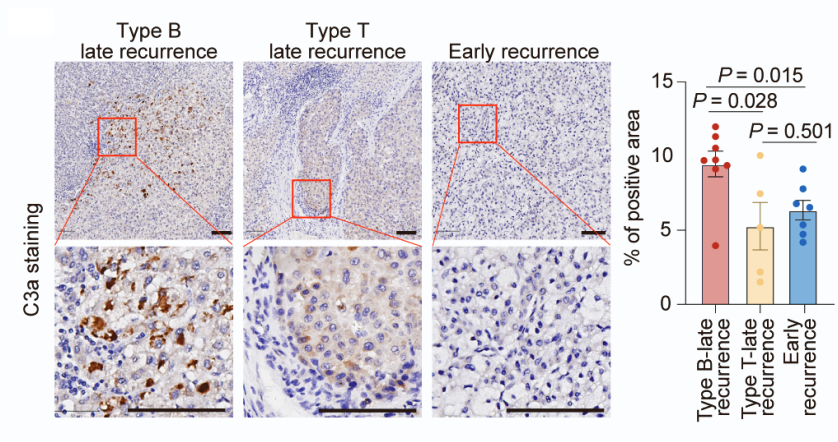
Recurrent hepatocellular-carcinoma patient cases were stratified into two immune subgroups: T-cell-dominated (Type-T) and B-cell-dominated (Type-B). Complement activation is markedly enhanced within the tumor microenvironment of Type-B patients, and complement fragment C3a functions as a central readout biomarker for this process.
To visualize in-situ C3a protein deposition within patient tumor tissue sections, scientists used Cloud-Clone C3a polyclonal antibody (PAA387Hu01) for immunohistochemistry (IHC). Distinct staining patterns clearly separated immune-microenvironment features between different recurrence subgroups and furnished robust histological evidence for complement-driven anti-tumor activity.
Clinical patient tissue samples are scarce, and IHC workflows carry very low tolerance for experimental failure, with limited opportunities for repeat testing. Acceptance of these IHC datasets by Cancer Cell reviewers validated combined strengths of the antibody: specificity, sensitivity and consistent batch-to-batch reproducibility.
Figure 1. IHC staining for C3a across hepatocellular-carcinoma patient tissue subgroups with different recurrence phenotypes. Experiments performed with Cloud-Clone C3a polyclonal antibody for the Cancer Cell liver-cancer immunology study.
3. Parallel Profiling with 14 Antibodies: High-Throughput IHC Assays Validate Consistency Across Cloud-Clone Antibody Panels
Unlike the two prior projects centered on individual target molecules, work from the Institute of Nano Science and Technology, India, published in Advanced Science, assessed antibody-library breadth and batch-consistency across multiple separate products.
Inflammatory bowel disease (IBD) frequently presents with psychiatric comorbidities such as anxiety and depression, yet mechanistic links along the gut-brain axis remain incompletely characterized. This research team developed an oral β-gluc-encapsulated nanomedicine βG@Apr-WPG NMs to treat ulcerative colitis and its associated neuropsychiatric manifestations, and systematically characterized how this nanotherapeutic reshapes the microbiota-gut-brain signalling axis.
To comprehensively evaluate drug efficacy, investigators needed simultaneous detection of more than ten key proteins within colon tissues. Assessed targets spanned inflammatory signalling (TLR4, STING, NF-κB, NLRP3), intestinal-barrier components (MUC2, Occludin, ZO-1, Claudin), and immune-metabolism markers (CD8, AMPK).
Researchers deployed 14 distinct Cloud-Clone polyclonal antibodies to complete the full IHC biomarker panel. Every target generated high-signal-to-noise-ratio staining outputs, and all reagents delivered stable performance. These datasets strongly supported the complete mechanistic conclusion for the nanomedicine: intestinal-barrier repair → inflammatory suppression → mitigation of neuroinflammation.
Running 14 antibody assays in parallel creates high experimental risk. Non-specific binding or batch-variability for any single antibody would compromise cross-group comparability for the entire dataset. Reliable multi-target-panel delivery relies not merely on discrete technical strengths but on mature, large-scale quality-control infrastructure.
Figure 2. Immunohistochemical profiling of colon-tissue specimens using a panel of 14 Cloud-Clone polyclonal antibodies for gut-brain-axis research published in Advanced Science.
Beyond Isolated Success Stories: Cloud-Clone Antibodies Consistently Appear in Global High-Impact Publications
These three high-profile papers are not isolated incidents. By the end of 2025, Cloud-Clone reagents had been cited in more than 42,000 SCI-indexed publications, among which over 350 papers appear in elite journals including Nature, Science and Cell.
This trend reflects broader transformation within the global research-reagent industry. Reagent offerings are evolving beyond low-cost alternatives, achieving performance parity with globally-established brands.
Cloud-Clone originally built capabilities within the ELISA-kit market historically dominated by overseas suppliers. Today the enterprise operates polyclonal-antibody, monoclonal-antibody and recombinant-antibody technical platforms, securing full independent control over core raw-material supplies. Its in-house native antibody repository holds more than 27,000 entries. Compatible conjugation supports over 30 reporter labels, generating nearly one-million derived antibody resources covering tens-of-thousands of research targets, encompassing both heavily-studied signalling pathways and less-common niche biomarkers.
Concurrent with portfolio expansion, Cloud-Clone maintains a three-layer closed-loop validation workflow combining internal functional testing, third-party verification and literature-derived supporting evidence. Both polyclonal and monoclonal antibodies undergo multi-platform quality assessment including western blot, IHC, immunofluorescence and flow cytometry, with strict checks for specificity, sensitivity and batch-to-batch stability.
This robust quality-control infrastructure satisfies two divergent experimental demands: the ultra-high-specificity requirements for single-target studies featured in Nature, as well as multi-antibody high-throughput screening workflows represented by the Advanced Science publication.
Polyclonal and monoclonal antibodies represent two major technical approaches for research applications, each suited for distinct experimental contexts according to investigator priorities. Cloud-Clone does not represent one novel antibody technology; rather, it delivers a brand-level commitment for global research users: whether polyclonal or monoclonal products are selected, Cloud-Clone guarantees stable, reproducible reagent performance paired with dedicated technical support. This brand promise is encapsulated in its core slogan: Polyclonal, Monoclonal, Cloud-Clone.
Three top-journal publications, three drastically different experimental scenarios, all returning valid, publishable datasets. Cloud-Clone antibodies have successfully passed stringent specificity benchmarks set by Nature, rigorous clinical-tissue IHC requirements from Cancer Cell, and multi-reagent consistency tests for high-throughput workflows in Advanced Science. Repeated adoption by independent research teams across multiple countries is therefore unsurprising.
These achievements extend beyond one single enterprise and mark a meaningful milestone for the global research-reagent industry. Over the past two decades, life-science research output has expanded enormously across the world. For the decades ahead, research tools originating from new-generation reagent manufacturers are building trust within the global scientific community through mounting high-impact published evidence. Concurrent adoption of Cloud-Clone reagents across these three influential publications stands as powerful testament to advancing reagent-product performance.
About Cloud-Clone Corp.
Cloud-Clone Corp. is dedicated to the development and production of high-quality immunoassay reagents and detection solutions. With a focus on antibody engineering, multiplex assay development, and cross-platform compatibility, the company provides research tools designed to support precision medicine and advanced biomedical investigation globally. Our core products and services include the research and development of proteins, antibodies, ELISA kits, primary cells, and multiplex cytokine assay kits, as well as professional CRO services to fully meet the diverse needs of biomedical research and related fields.
For more information about Cloud-Clone Corp, visit www.cloud-clone.com.
CLOUD-CLONE CORP.(CCC)
Tel: 001-832-538-0970, 0086-27-8425-9552
Email: mail@cloud-clone.com, sales@cloud-clone.us
Visit us on social media:
LinkedIn: https://www.linkedin.com/company/cloud-clone-corp/
Instagram: https://www.instagram.com/cloudclonecorp2023/
TickTok: https://www.tiktok.com/@cloudclonecorp2026
SuKi Duan
CLOUD-CLONE CORP.WUHAN
email us here
Visit us on social media:
LinkedIn
Instagram
TikTok
X
Legal Disclaimer:
EIN Presswire provides this news content “as is” without warranty of any kind. We do not accept any responsibility or liability
for the accuracy, content, images, videos, licenses, completeness, legality, or reliability of the information contained in this
article. If you have any complaints or copyright issues related to this article, kindly contact the author above.

Media gallery