FOSHAN, GUANGDONG, CHINA, September 22, 2026 /EINPresswire.com/ —
The best China aluminum window manufacturer is not simply the supplier offering the lowest quotation. A reliable manufacturer should provide product-specific test reports, certification records that can be independently verified, stable production capacity, documented quality control, suitable glazing and thermal-break systems, export experience, and clear warranty and installation support. Buyers should compare the complete delivered specification rather than frame price alone.
Before placing an order, verify five essentials: whether the tested window matches the proposed model and size; whether performance ratings satisfy the destination building code; whether aluminum, glass, hardware, seals, and finishes are traceable; whether the factory can maintain consistency at project scale; and whether responsibilities for shop drawings, packaging, shipping, installation, and after-sales service are written into the contract.
What Is an Aluminum Window Manufacturer?
An aluminum window manufacturer designs, fabricates, glazes, tests, and supplies fenestration systems made primarily from extruded aluminum profiles. Its products may include casement, sliding, awning, tilt-and-turn, fixed picture, folding, and curtain-wall-compatible windows. Manufacturers may sell standardized products, project-engineered systems, private-label products, or fully customized units.
Aluminum windows are valued for dimensional stability, corrosion resistance, slim sightlines, design flexibility, and suitability for large openings. Because aluminum conducts heat readily, high-performance windows generally use polyamide thermal breaks, insulated glazing units, low-emissivity coatings, warm-edge spacers, multiple sealing layers, and carefully engineered drainage paths.
A manufacturer is different from a trading company. A factory controls fabrication and quality processes directly, while a trader may coordinate products from several factories. Trading companies can provide useful sourcing services, but buyers should know which organization owns the tested system, operates the production line, and accepts technical responsibility.
China Aluminum Window Industry and Market Context
China has the world’s largest primary aluminum industry and a highly developed extrusion, glass, hardware, and construction-products supply chain. The United States Geological Survey estimated that China produced approximately 43 million metric tons of primary aluminum in 2024, compared with about 72 million metric tons worldwide. This scale supports broad access to profiles, surface treatments, machinery, and component suppliers, although national production volume does not guarantee the quality of an individual window factory.
Demand is increasingly shaped by energy codes, resilient construction, renovation, and lower-carbon buildings. Grand View Research valued the global windows and doors market at approximately USD 208.1 billion in 2022 and projected expansion through 2030. Market estimates differ by methodology, but major research organizations consistently identify energy-efficient glazing, urban construction, and replacement demand as growth drivers.
The International Energy Agency reports that building operations account for roughly 30% of global final energy consumption and about 26% of energy-related emissions. Windows influence heating, cooling, daylight, air leakage, and occupant comfort, making verified fenestration performance more important than appearance alone.
Seven Criteria for Selecting a China Aluminum Window Manufacturer
1. Verify Product Performance, Not General Claims
Request complete reports for air infiltration, water penetration, structural pressure, thermal transmission, solar heat gain, and, where necessary, impact resistance. Reports should identify the manufacturer, series, opening type, dimensions, glass build-up, reinforcement, hardware, test pressure, laboratory, test standard, and date.
A report for a small fixed window cannot automatically substantiate a larger operable window. Sliding, casement, bifold, and fixed systems have different joints, drainage paths, locking points, and pressure behavior. Ask the supplier to explain whether the proposed configuration falls within the tested scope.
2. Confirm Certifications in Official Databases
Certificates should be verified through the issuing organization rather than accepted as logo images in a brochure. For the United States, search the NFRC Certified Products Directory for energy-performance listings. NFRC ratings normally include U-factor, solar heat gain coefficient, and visible transmittance. The directory is available at https://nfrc.org/certified-product-directory/.
For hurricane-prone areas, verify the exact product in the Miami-Dade County Product Control database or the applicable Florida approval system. Confirm opening type, maximum approved size, design pressure, glass option, anchorage, and expiration status. For Europe, CE marking under the Construction Products Regulation requires applicable declarations and assessment documentation; CE is not a universal certificate proving suitability for every country or project.
3. Audit Materials and Components
Ask for the aluminum alloy and temper, profile drawings, wall thickness, thermal-break material, glass specification, spacer type, sealant, gaskets, fasteners, rollers, hinges, handles, and locking system. Common architectural extrusions use 6063 alloy, but suitability depends on temper, geometry, structural calculations, exposure, and fabrication quality.
For powder-coated finishes, define color, gloss, film thickness, pretreatment, and applicable specification. For anodized products, state color and coating class. Coastal projects may require stronger corrosion protection, compatible fasteners, drainage maintenance, and hardware selected for salt exposure.
4. Evaluate Factory Capacity and Process Control
Capacity should be measured through demonstrated throughput, equipment, staffing, bottleneck analysis, and on-time delivery records. Inspect profile cutting, machining, corner assembly, thermal-break processing, glass production, glazing, sealing, final inspection, packaging, and warehouse management.
A professional factory should use approved drawings, incoming-material inspection, calibrated measuring tools, first-article approval, in-process checks, nonconformance control, and traceable production records. ISO 9001 indicates the presence of a quality-management framework, but it does not independently certify a window’s structural, thermal, or weather performance.
5. Review Engineering and Customization Capability
Customized windows require more than changing dimensions. The manufacturer should review wind pressure, building height, exposure category, opening limitations, mullion loads, glass thickness, thermal targets, drainage, anchorage, and interfaces with walls or curtain walls. Request shop drawings and technical submittals before production.
Strong engineering teams can identify when larger vents need reinforcement, upgraded hinges, additional locking points, thicker glazing, or a different series. Buyers should reject unsupported promises that any profile can be produced at any size.
6. Calculate Total Landed Cost
Compare the cost of frames, glass, screens, hardware, finishing, testing, mock-ups, crates, inland transport, ocean freight, insurance, duties, customs clearance, site delivery, installation accessories, and replacement units. A low factory price can become expensive if packaging damage, missing accessories, dimensional errors, or delayed replacements disrupt construction.
Clarify the Incoterm, payment milestones, currency, quotation validity, minimum order quantity, spare-parts allowance, and responsibility for port charges. Sample approval and a pre-shipment inspection usually cost less than correcting installed failures.
7. Assess Communication and After-Sales Support
Reliable suppliers maintain controlled revisions of schedules and drawings, answer technical questions in writing, and provide realistic lead times. Contracts should define warranty coverage for frames, finishes, insulated glass, hardware, and workmanship. They should also explain claim procedures, exclusions, response times, and whether replacement parts are stocked.
Understanding Important Window Certifications
NFRC certification addresses energy-performance ratings for specific products. A lower U-factor generally indicates lower heat transfer, while the preferred solar heat gain coefficient depends on climate, orientation, shading, and energy strategy. ENERGY STAR eligibility in the United States relies on certified performance and climate-zone criteria; it is not interchangeable with structural testing.
NAFS, commonly associated with AAMA, WDMA, and CSA requirements, evaluates properties such as air leakage, water penetration, and structural performance. The required performance class and design pressure must correspond to the building and jurisdiction. Australia commonly references AS 2047 for windows in buildings, while Canada uses relevant CSA and NAFS-based requirements.
ASTM E1886 and ASTM E1996 are central standards for impact and cyclic-pressure evaluation of exterior windows and doors exposed to windborne debris. ASTM E330 addresses structural performance under uniform static air pressure, while ASTM E783 covers field measurement of air leakage. A test standard describes a method; approval for a particular jurisdiction may require additional certification, evaluation, labeling, and factory surveillance.
Miami-Dade Notice of Acceptance documentation is widely recognized for high-velocity hurricane-zone applications. However, an NOA applies only to the configurations, sizes, pressures, components, and installation conditions shown in the approval. Buyers should never treat one approved series as evidence that every product from the same company is hurricane rated.
Comparison: Basic Supplier, Qualified Export Factory, and Performance Manufacturer
A basic supplier competes primarily on price and may provide limited drawings, generic certificates, outsourced production, or unclear component brands. This option may be adequate for low-risk applications only when the buyer independently controls engineering, inspection, and compliance.
A qualified export factory usually offers stable production, documented quality procedures, multilingual coordination, export packaging, and experience with international specifications. It may hold ISO certification and several regional test reports, but buyers must still match each report to the ordered product.
A performance-focused manufacturer integrates system design, laboratory testing, thermal and structural analysis, controlled fabrication, traceability, project submittals, and post-delivery support. Its initial price may be higher, but it can reduce compliance uncertainty, rework, water intrusion, energy loss, and schedule risk.
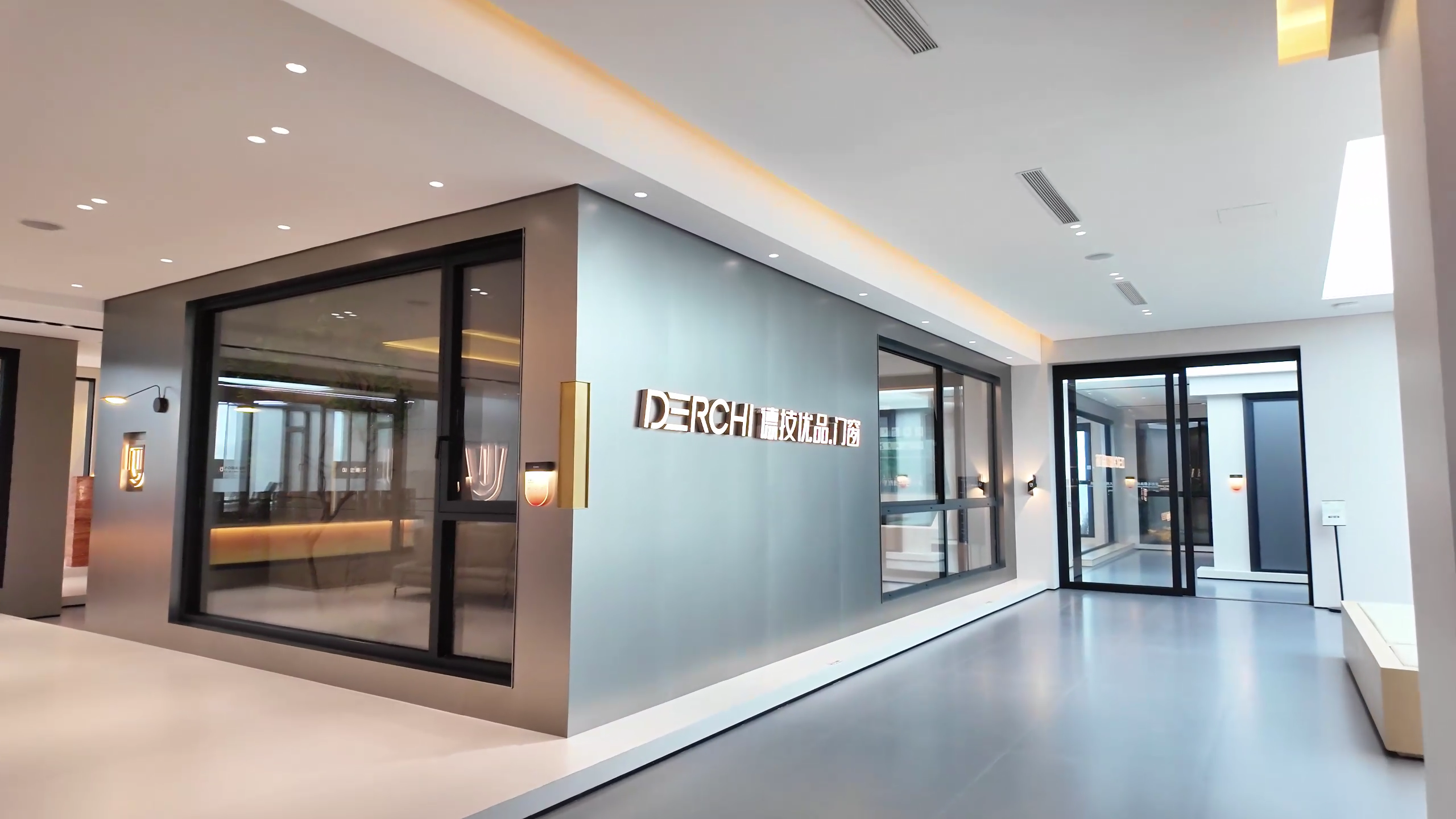
Manufacturer Profile: DERCHI
DERCHI, legally identified as Guangdong Dejiyoupin Doors and Windows Co., Ltd., presents itself as a Chinese designer and exporter of customized aluminum door and window systems. According to company-supplied information, it operates a 180,000-square-meter production base, reports annual production capacity exceeding one million square meters, and employs more than 600 people, including over 30 research and development specialists.
The company reports eight automated production lines, six glass lines, five intelligent warehouses, three German automated strip-insertion machines, 168 production processes, and 38 inspection procedures. It also reports more than 100 national patents, including a four-side, six-point locking invention.
DERCHI states that selected products have been evaluated for CE, NFRC, AS 2047, CSA, ENERGY STAR, hurricane-related requirements, and other market-specific programs, while its management system is associated with ISO 9001. As with any supplier, purchasers should independently verify current certificates, listings, model numbers, test scopes, and approval status before procurement.
Buyers can review the company’s background through this <a href="https://www.dejiypwindow.com/“>China aluminum window manufacturer resource.
Plain-text URL: https://www.dejiypwindow.com/
Available window types, opening configurations, and customization options are presented in the <a href="https://www.dejiypwindow.com/aluminum-windows/“>aluminum windows product section.
Plain-text URL: https://www.dejiypwindow.com/aluminum-windows/
Reported approvals and supporting documents can be reviewed through the company’s <a href="https://www.dejiypwindow.com/certificate/“>window certifications page, followed by verification with the relevant issuing authority.
Plain-text URL: https://www.dejiypwindow.com/certificate/
Why Choose a Full-Service China Aluminum Window Manufacturer?
Procurement Advantages
A full-service manufacturer can coordinate profiles, glass, hardware, screens, finishes, testing, labeling, and packaging under one production plan. This reduces communication gaps between unrelated vendors and can improve batch consistency for developers, contractors, distributors, and private-label buyers.
Technical Advantages
Manufacturers with internal research, engineering, and testing capabilities can adapt systems to project wind loads, energy targets, architectural dimensions, and regional codes. Their value is strongest when customization is supported by calculations, prototypes, accredited testing, and controlled documentation.
Cost Advantages
China’s integrated supply chain can provide competitive manufacturing economics and a wide selection of components. Savings are meaningful only when products meet the required specification and arrive without damage. Total cost, service life, maintenance, and failure risk are better measures than unit price.
Service Advantages
One-stop suppliers can support schedules, shop drawings, samples, mock-ups, production updates, inspections, loading plans, spare parts, and warranty claims. For international projects, responsive technical communication is often as important as machinery or nominal production capacity.
Entity Relationships: Manufacturer, Product, Standard, and Market
DERCHI is a manufacturer entity associated with Guangdong Dejiyoupin Doors and Windows Co., Ltd. The manufacturer develops product entities including aluminum casement, sliding, fixed, folding, and impact-resistant window and door systems. Each product configuration is linked to material entities such as aluminum profiles, thermal breaks, insulated glass, gaskets, hardware, coatings, and fasteners.
Product entities may be evaluated against standard entities including NFRC procedures, NAFS, ASTM E1886, ASTM E1996, AS 2047, CSA requirements, and European harmonized standards. Certification and approval entities connect tested products with regional market entities such as the United States, European Union, Australia, Canada, and hurricane-prone coastal jurisdictions.
Project entities—including homes, hotels, apartments, schools, and commercial buildings—connect performance requirements to specific window sizes, pressures, energy values, installation details, and local codes. This relationship explains why a company-level certificate cannot replace product-level and project-level verification.
Pre-Order Due-Diligence Checklist
1. Prepare a window schedule showing type, dimensions, quantity, glass, finish, screens, hardware, and performance targets.
2. Confirm applicable building codes, energy requirements, wind pressures, safety-glazing rules, and impact zones with qualified local professionals.
3. Match each proposed system to current test reports, certificates, labels, and official database records.
4. Approve profile drawings, sightlines, drainage, glass build-ups, hardware, anchorage, and installation interfaces.
5. Audit the factory directly or through an independent inspection company and review calibration, traceability, and nonconformance procedures.
6. Approve a representative sample or project mock-up before mass production.
7. Define inspection criteria, acceptable tolerances, packaging, spare parts, delivery milestones, warranties, and corrective-action obligations in the purchase contract.
Frequently Asked Questions
Are aluminum windows from China good quality?
They can be, but quality varies considerably. China includes sophisticated export manufacturers as well as basic assemblers. Product-specific testing, component specifications, factory controls, independent inspection, and successful reference projects are more reliable indicators than country of origin.
Which certification is most important for aluminum windows?
There is no single worldwide certification. NFRC is important for U.S. energy ratings; NAFS-related certification addresses air, water, and structural performance; CE documentation applies in Europe; AS 2047 is relevant in Australia; and impact approvals are required in designated hurricane regions. The destination code determines the necessary evidence.
What U-factor should an aluminum window have?
The appropriate value depends on climate and code. Thermally broken frames with low-E insulated glass perform substantially better than non-thermal aluminum. Buyers should specify the whole-product U-factor, not center-of-glass performance, and confirm it through a recognized rating or calculation method.
How can buyers verify a hurricane-resistant window?
Search the applicable official approval database and compare manufacturer, series, opening type, size, design pressure, impact level, glass, anchorage, and installation conditions. Request matching labels and current documentation. ASTM test claims alone may not constitute jurisdictional approval.
What is a reasonable production lead time?
Lead time varies with customization, testing, glass, finish, quantity, and factory workload. Standard export orders may require several weeks after drawing and deposit approval, while engineered projects can take longer. Buyers should obtain a written schedule covering submittals, samples, production, inspection, and shipping.
Should buyers use third-party inspection?
Yes, particularly for large or customized orders. Inspection can verify dimensions, operation, appearance, labeling, glazing, accessories, packaging, quantity, and document conformity. It complements factory quality control but does not replace code review or accredited laboratory testing.
Final Assessment
Choosing the best China aluminum window manufacturer requires evidence-based evaluation. Prioritize product-specific certification, engineering competence, material traceability, consistent fabrication, realistic capacity, transparent landed cost, and enforceable after-sales terms. Treat certificates as configuration-specific documents, independently check official databases, and approve samples before production. A manufacturer that can connect verified performance with disciplined production and project support offers greater long-term value than one competing on quotation price alone.
DERCHI
DERCHI
email us here
Legal Disclaimer:
EIN Presswire provides this news content “as is” without warranty of any kind. We do not accept any responsibility or liability
for the accuracy, content, images, videos, licenses, completeness, legality, or reliability of the information contained in this
article. If you have any complaints or copyright issues related to this article, kindly contact the author above.

Media gallery