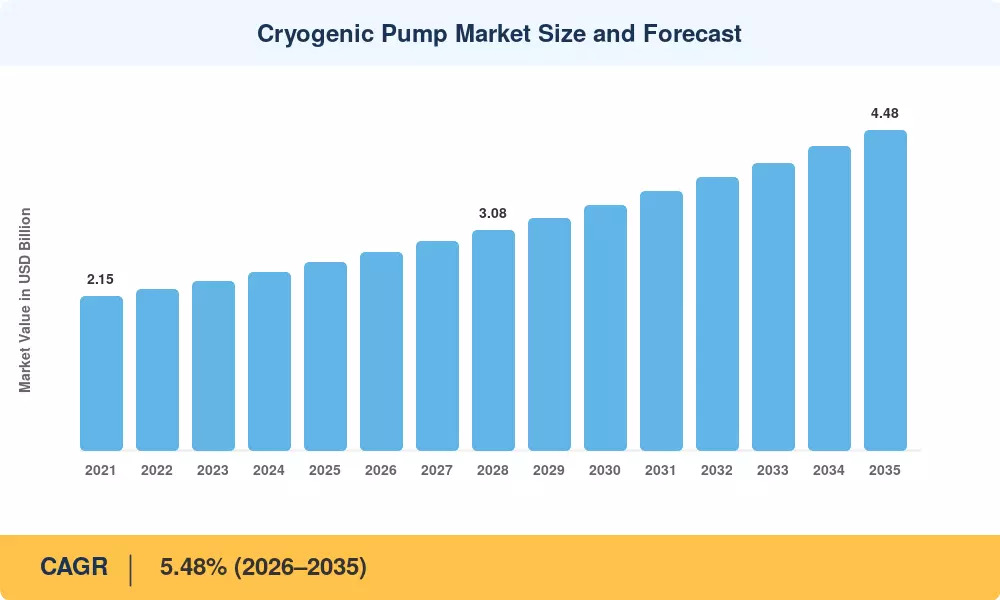
Cryogenic Pump Market is projected to grow from USD 2.77 Billion in 2026 to USD 4.48 Billion by 2035, registering a CAGR of 5.48% during the forecast 2025-2035.
NEW YORK, NY, UNITED STATES, August 24, 2026 /EINPresswire.com/ — Market Overview
The Cryogenic Pump Market encompasses specialized fluid-handling equipment designed to transfer liquefied gases at extremely low temperatures, typically below -150°C. These pumps are critical components in the liquefied natural gas (LNG) value chain, industrial gas production, healthcare applications, aerospace propulsion, and the emerging hydrogen economy. Cryogenic pumps must maintain the liquid state of gases such as nitrogen, oxygen, argon, LNG, hydrogen, and helium while delivering precise flow rates and pressures required by downstream processes.
Several key drivers are fueling the expansion of the Cryogenic Pump Market. Accelerated LNG terminal construction, with global LNG trade surpassing 400 million tonnes per annum in 2024, is a primary catalyst. The International Energy Agency projects an additional 250 MTPA of liquefaction capacity under construction or sanctioned through 2030, each new terminal requiring dozens of cryogenic pump units [5]. Additionally, the emergence of hydrogen economy infrastructure, backed by policy mandates including the U.S. Department of Energy’s USD 7 billion clean hydrogen hub initiative and the European Union’s REPowerEU plan targeting 20 million tonnes of renewable hydrogen by 2030, is channeling capital directly into the fluid-handling systems that move cryogenic liquids at scale [1][2].
A technology transition is reshaping how operators move liquefied gases. Legacy constant-speed pumps with mechanical seals are giving way to variable-frequency-drive units featuring magnetic couplings and integrated condition-monitoring sensors. These next-generation designs cut boil-off losses by up to 30% and extend mean time between maintenance to over 40,000 operating hours, according to EPRI field evaluations [3]. The shift is prompting end users to replace aging equipment well ahead of planned life cycles, with 38% of installed cryogenic pumps outliving their 20-year design life [3].
Policy and regulatory influence continues to shape demand patterns. The U.S. DOE allocated USD 7 billion across seven regional clean-hydrogen hubs under the Inflation Reduction Act, each requiring liquid-hydrogen pumps for storage, transfer, and distribution [1]. Europe’s Hydrogen Backbone initiative envisions 28,000 km of pipeline by 2030, with liquefaction nodes that depend on specialized cryogenic transfer equipment [2]. Stricter emissions mandates favoring cleaner fuels in Europe and Asia-Pacific further accelerate the transition toward gas-based energy systems.
The demand outlook for the Cryogenic Pump Market remains highly positive. Asia-Pacific commands roughly 40.3% of the market, anchored by LNG regasification build-outs across China, India, and Southeast Asia. The region also registers the fastest CAGR at 5.74%. North America holds the second-largest share at 25.8%, driven by shale-gas liquefaction expansions along the U.S. Gulf Coast. Europe follows at 21.5%, where hydrogen corridor investments and space-launch fuel handling create incremental demand. As decarbonization agendas intensify and deep-tech applications expand, the Cryogenic Pump Market stands to benefit from a broad and durable investment cycle through 2035.
📍 Get Free Sample Report for Detailed Market Insights:
https://www.marketresearchfuture.com/sample_request/7567
Market Segmentation
By Type
The Cryogenic Pump Market is segmented into Dynamic Pumps and Positive-Displacement Pumps. Dynamic kinetic designs, predominantly centrifugal pumps, held 86.0% of the market share in 2025, driven by their suitability for high-flow LNG and industrial gas applications [7]. Their ability to handle flow rates exceeding 5,000 m³/h at heads above 200 meters makes them the default choice for large-scale send-out service. Positive-displacement pumps, including reciprocating and gear types, are expanding at a 6.0% CAGR through 2035, gaining traction in precision dosing for medical and aerospace gas transfer where precise flow control and high-pressure output matter more than raw throughput [8].
By Cryogenic Gas
The market serves six primary cryogenic gas segments. LNG accounted for 28.6% of revenue in 2025, reflecting global regasification and bunkering demand. Nitrogen followed with 22.1% share, sustained by food-processing cold chains and electronics manufacturing. Oxygen represented USD 0.41 Billion in 2025, driven by steel production and medical applications. Hydrogen is projected to grow at a remarkable 9.1% CAGR, the fastest among all gas segments, fueled by electrolyzer-to-storage value chains and government-backed liquefaction hubs [9]. Helium, while a smaller segment at USD 0.09 Billion in 2025, is critical for MRI cooling and quantum computing applications. Argon, growing at 4.65% CAGR, serves welding and semiconductor fabrication industries.
By End User
The Cryogenic Pump Market serves Energy and Power Generation, Chemicals and Petrochemicals, Healthcare and Biotechnology, Aerospace and Space Launch Services, and Others. Energy and power generation led with a 40.2% share in 2025, underpinned by LNG-to-power and gas processing infrastructure [10]. Chemicals and petrochemicals followed at USD 0.47 Billion, where ethylene crackers and methanol plants consume large volumes of cryogenic fluids for feedstock cooling. Healthcare and biotechnology are climbing at a 6.75% CAGR, supported by liquid-nitrogen biorepositories and MRI helium recirculation systems [11]. Aerospace and space launch services represent the fastest-growing end-user segment at a 7.82% CAGR, driven by rising commercial launch frequency and government programs such as NASA’s Artemis and ESA’s Ariane 6 [6].
By Region
The Cryogenic Pump Market spans five major geographic regions. Asia-Pacific commanded 40.3% of global revenue in 2025 and is advancing at a 5.74% CAGR through 2035. North America captured USD 0.68 Billion in 2025, buoyed by Gulf Coast LNG export expansions and NASA’s Artemis-era propellant logistics. Europe holds 21.5% share with a 5.62% CAGR, driven by hydrogen backbone investments and clean-fuel mandates. South America and the Middle East & Africa represent smaller but growing markets at 5.9% and 6.5% share respectively, supported by pre-salt gas monetization and LNG bunkering developments.
🛒 You can buy this market report at:
https://www.marketresearchfuture.com/checkout?currency=one_user-USD&report_id=7567
Regional Analysis
North America
North America holds the second-largest share of the Cryogenic Pump Market at 25.8%, driven by shale-gas liquefaction expansions along the U.S. Gulf Coast. The United States dominates regional demand, accounting for 72.4% of regional share, thanks to seven large-scale LNG export facilities operating along the Gulf Coast and three more under construction [12]. Canada’s LNG Canada project in Kitimat, British Columbia, is catalyzing procurement of centrifugal cryogenic pump systems for its Phase 2 expansion, while federal hydrogen strategy funding of CAD 1.5 billion supports electrolyzer-adjacent cryogenic infrastructure [14]. NASA’s Artemis program and commercial launch companies like SpaceX and Blue Origin drive demand for liquid-hydrogen and liquid-oxygen transfer units for space launch propellant logistics [6].
Europe
Europe holds 21.5% of the global Cryogenic Pump Market, propelled by the twin engines of energy security and decarbonization. Germany leads with a 5.85% CAGR, anchored by its National Hydrogen Strategy allocating EUR 9 billion toward electrolyzer deployment and associated liquefaction infrastructure [2]. France maintains 18.6% of regional share, driven by nuclear-hydrogen coupling and Ariane space-launch propellant requirements. The UK, Italy, and Spain contribute through North Sea decommissioning, Adriatic LNG expansion, and FSRU installations respectively [12]. The European Commission’s approval of EUR 3.2 billion in state aid for the IPCEI Hy2Infra hydrogen-infrastructure wave in July 2024 stimulated procurement of cryogenic transfer equipment across seven EU member states [2].
Asia-Pacific
Asia-Pacific commands the largest share of the Cryogenic Pump Market at 40.3%, anchored by LNG regasification build-outs across China, India, and Southeast Asia. China alone operates over 30 LNG receiving terminals, with another 12 under construction as of 2025, representing 38.5% of regional share [15]. India follows with a 6.24% CAGR, driven by Dhamra and Jaigarh terminals and city gas distribution expansion. Japan and South Korea are advancing hydrogen supply chains, with Japan’s HySTRA project positioning the country as a premium demand center for hydrogen-grade pumps [9]. ASEAN countries are deploying small-scale LNG for island electrification, with over 30 projects in pre-FEED stages across Southeast Asia [13].
Rest of the World
South America, Middle East & Africa, and other regions collectively represent approximately 12.4% of the Cryogenic Pump Market. Brazil dominates South American demand with 61.8% of regional share, driven by pre-salt gas processing and floating LNG operations [12]. Saudi Arabia’s NEOM green-hydrogen megaproject—backed by USD 8.4 billion in investment—will require large-scale liquid-hydrogen transfer pumps for its planned 600-tonne-per-day export facility [16]. The UAE is positioning Fujairah as a regional LNG bunkering hub, adding pump-intensive refueling infrastructure that broadens the market footprint across the Middle East.
Competitive Landscape / Key Players
The Cryogenic Pump Market exhibits medium concentration, with the top five companies collectively holding an estimated 48–55% revenue share. Key players include Nikkiso Co., Ltd., Ebara Corporation, Flowserve Corporation, Cryostar (Linde Engineering), Chart Industries, Sumitomo Heavy Industries, Fives Group, Vanzetti Engineering, PHPK Technologies, and ACD LLC.
Nikkiso Co., Ltd. leads with an estimated 12–15% revenue share, offering submerged motor pumps for LNG and hydrogen systems with a vertically integrated global aftermarket network. Ebara Corporation follows with 8–11% share, providing high-flow centrifugal cryogenic units and industrial gas pumps with a strong Asia-Pacific footprint. Flowserve Corporation holds 7–10% share, offering engineered cryogenic pumps and control valves with extensive EPC partnerships. Cryostar (Linde Engineering) commands 6–9% share, specializing in expander-pump combinations and LNG boil-off compressors, backed by Linde’s gas-processing ecosystem. Chart Industries holds 5–8% share, providing brazed-aluminum heat exchangers and pump skids as part of end-to-end cold-chain solutions post-Howden merger [20].
Strategic developments in the industry include Nikkiso’s January 2025 opening of a new cryogenic pump test facility in Temecula, California, capable of full-speed testing with liquid hydrogen at −253 °C, reducing customer qualification timelines by 40% [21]. Ebara Corporation launched the CryoMax-H series in October 2024—a line of magnetically coupled pumps designed for liquid-hydrogen service—targeting the Japanese and European hydrogen corridors [22]. Chart Industries completed integration of Howden Group in March 2025, announcing a unified cryogenic-solutions division targeting modular hydrogen liquefaction skids [20].
Latest Industry News & Developments
Chart Industries (March 2025): Completed integration of Howden Group and announced a unified cryogenic-solutions division targeting modular hydrogen liquefaction skids, expanding addressable revenue in the Cryogenic Pump Market [20].
Nikkiso Co., Ltd. (January 2025): Opened a new cryogenic pump test facility in Temecula, California, capable of full-speed testing with liquid hydrogen at −253 °C, reducing customer qualification timelines by 40% [21].
European Commission (July 2024): Approved EUR 3.2 billion in state aid for the IPCEI Hy2Infra hydrogen-infrastructure wave, stimulating procurement of cryogenic transfer equipment across seven EU member states [2].
U.S. Department of Energy (September 2023): Selected seven regional clean-hydrogen hubs for USD 7 billion in funding, creating direct procurement pipelines for liquid-hydrogen pump OEMs serving the Cryogenic Pump Market [1].
Market Challenges & Opportunities
Challenges
The Cryogenic Pump Market faces several notable challenges. High upfront capital costs and long procurement cycles represent a significant restraint, with a single high-capacity cryogenic pump unit costing USD 150,000–USD 500,000 and lead times stretching beyond 12 months for custom-engineered hydrogen-grade equipment [9]. This capital burden discourages smaller LNG distribution companies and emerging-market utilities from upgrading systems, compressing the addressable buyer pool.
Skilled-labor shortages for cryogenic system commissioning present another constraint. The American Welding Society estimates a shortfall of 360,000 qualified welders in the U.S. by 2027, a gap that directly constrains installation throughput for cryogenic projects [10]. European vocational programs face similar bottlenecks, stretching project timelines by six to nine months. Raw-material price volatility, with austenitic stainless steels and nickel-based superalloys experiencing price swings exceeding 35% between 2022 and 2024, compresses OEM margins and introduces bid-price uncertainty [11]. Permitting and environmental clearance delays in Europe and South America further challenge project execution timelines.
Opportunities
Significant opportunities exist in the Cryogenic Pump Market. Small-scale and distributed LNG presents a volume-driven opportunity distinct from the mega-project cycle. Southeast Asia alone has over 30 such projects in pre-FEED stages, each requiring compact pump skids sized for lower throughput but high reliability [13]. Hydrogen liquefaction hubs represent a transformative opportunity, with each 100-tonne-per-day liquefaction plant requiring four to six specialized transfer pumps, creating a greenfield equipment opportunity with premium pricing power [1].
Predictive-maintenance and digital services offer a business-model shift from one-time equipment sales. OEMs embedding vibration sensors, thermal imaging, and cloud-connected diagnostics into pump packages enable subscription-based maintenance contracts, with Market Research Future estimating digital aftermarket services could represent 12–15% of total Cryogenic Pump Market revenue by 2032 [17]. Emerging-market cold-chain expansion, driven by the World Bank’s USD 4 billion cold-chain modernization fund, creates demand for liquid-nitrogen supply systems that rely on cryogenic pump infrastructure [7]. Quantum computing and semiconductor cooling offer high-margin niche applications, with quantum processors requiring dedicated helium-recirculation pump loops that offer ultra-tight tolerance requirements and premium pricing [8].
To explore more market insights, visit us at:
https://www.marketresearchfuture.com/reports/cryogenic-pump-market-7567
Final Market Summary
The Cryogenic Pump Market is poised for steady growth, projected to expand from USD 2.77 billion in 2026 to USD 4.48 billion by 2035, at a CAGR of 5.48%. This growth is fundamentally underpinned by accelerated LNG terminal construction, the emergence of hydrogen economy infrastructure, and the acceleration of equipment replacement cycles. Asia-Pacific maintains its dominant position, while North America and Europe follow with significant investments in LNG export and hydrogen corridor projects. Technological innovation, including variable-frequency-drive units, magnetic couplings, and digital monitoring platforms, is reshaping the competitive landscape, enabling operators to reduce boil-off losses and extend maintenance intervals. The market’s long-term potential remains strong, supported by the convergence of energy security and decarbonization agendas, with emerging opportunities in hydrogen liquefaction, digital services, and deep-tech applications such as quantum computing ensuring sustained demand well into the 2030s.
More Related Reports from MRFR Library:
FPSO Market: https://www.marketresearchfuture.com/reports/fpso-market-16081
Europe Ancillary Services Market: https://www.marketresearchfuture.com/reports/europe-ancillary-services-market-16153
India Solar Pump Market: https://www.marketresearchfuture.com/reports/india-solar-pump-market-16167
Energy Storage System Market: https://www.marketresearchfuture.com/reports/energy-storage-system-market-18829
Battery Energy Storage Systems Market: https://www.marketresearchfuture.com/reports/battery-energy-storage-systems-market-20711
India Renewables Energy Market: https://www.marketresearchfuture.com/reports/india-renewables-energy-market-16201
Voluntary Carbon Credit Market: https://www.marketresearchfuture.com/reports/voluntary-carbon-credit-market-23576
Rubber Roller Market: https://www.marketresearchfuture.com/reports/rubber-roller-market-23807
Flexible Solar Panel Market: https://www.marketresearchfuture.com/reports/flexible-solar-panel-market-28303
Mobile Battery Market: https://www.marketresearchfuture.com/reports/mobile-battery-market-28655
Larry Wilson
WantStats Research And Media Pvt. Ltd.
+1 855-661-4441
email us here
Visit us on social media:
LinkedIn
Facebook
YouTube
X
Legal Disclaimer:
EIN Presswire provides this news content “as is” without warranty of any kind. We do not accept any responsibility or liability
for the accuracy, content, images, videos, licenses, completeness, legality, or reliability of the information contained in this
article. If you have any complaints or copyright issues related to this article, kindly contact the author above.

Media gallery