
Flodesk Releases 2026 Email Marketing Trends Report, Debunking Myths and Revealing What Really Resonates
PR Newswire
SAN FRANCISCO, Aug. 19, 2026
An analysis of over 14 billion emails found that image-rich design, a targeted list, early-bird sends, and instant follow-ups are what actually perform
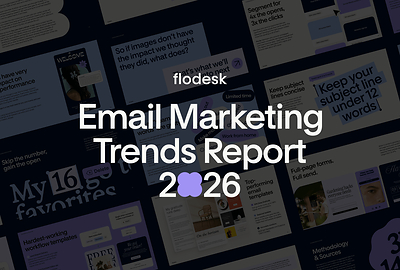
SAN FRANCISCO, Aug. 19, 2026 /PRNewswire/ — Flodesk, the email marketing platform used by over 100,000 small businesses and creators, today released its 2026 Email Marketing Trends Report, an analysis of over 14 billion emails from its members that finds many of the tactics marketers have relied on for a decade now have little effect on how an email performs. From image-to-text ratio to list targeting to automated follow-ups, the report offers fresh insight into what actually resonates with audiences today.
“Our findings show that so much of what we thought was gospel when it comes to email marketing either makes no difference or actively works against you,” said Rebecca Shostak, co-founder and CEO of Flodesk. “Email is one of the most powerful marketing tools a small business has, and we’re excited to share this report with our members and the broader industry to help people make a bigger impact when they connect with their customers and communities.”
Key findings from the report:
Everyone claims image-heavy emails underperform. They don’t.
Best practice has long held that a marketing email should be roughly 80% text and 20% images, the fear being that image-heavy emails are more likely to land in spam. Flodesk found that emails with more images significantly outperform those with far fewer. Campaigns where images fill at least a third of the email are opened 45% more often than mostly-text ones and earn 37% more clicks. In fact, no mailbox provider penalizes image-heavy emails, and text-only email campaigns were opened 34% below average, the weakest of any group.
“We went looking for evidence that a beautiful email costs you performance, because if it did, small businesses deserved to know. It isn’t there. The data shows that one of the most widely held beliefs about email performance is completely outdated; one of many misconceptions our report sets straight,” said Shostak.
The biggest mistake is emailing your entire list.
Sending to a segmented portion of a list sees open rates roughly 3.6x higher than full-list sends, and click rates roughly 3.3x higher.
The best time to send is much earlier than everyone thinks.
The best time to send a marketing email is 5 to 8 a.m. ET. In fact, emails sent in that early morning range are opened about 21% more often than at any other time, with 5 a.m. the strongest hour and midnight the weakest. The day barely matters, with gaps between weekdays under a percentage point, but Saturday is the worst day to send on both opens and clicks.
The best-performing emails go out automatically, seconds after someone acts.
An email triggered by a recipient’s own action–a purchase, a download, a signup–reaches the highest open rates on the platform: a post-purchase follow-up at roughly 2.7x the platform’s average, a requested-freebie delivery at about 2.5x. Emails sent on the business’s own schedule land at or below that average, and re-engagement emails to dormant subscribers do the worst of all. The highest-return message a business can send is often not another campaign, but a fast reply to something someone just did.
Only seven subject line phrases lead you into spam territory.
Of more than 70 phrases commonly blamed for landing email in spam, only seven measurably lower open rates, by 5 to 20 percentage points: “work from home,” “make money,” “limited time,” “guaranteed,” “hurry,” “don’t miss out,” and “act now.” What they share isn’t urgency; it’s that they read like a scam.
Long subject lines and numbers both cost open rates.
Subject lines of 12 or more words average 6% lower open rates than standard-length ones, and those over 90 characters 4% lower. Subject lines without a number see open rates up to 14% higher.
Everyone is getting the emoji rule wrong.
Conventional advice says keep emojis out of subject lines, or ration them. But using more than one turns out to have no measurable effect at all. Emoji placement affects open rates more than emoji count. Two emojis at the very start of a subject line lift opens up to 11%, while one buried mid-line, or a pair bookending it, can cost up to 31%. The runaway favorite emoji is the sparkle, used more than 230,000 times, followed by the party popper.
For access to all the data and insights, visit flodesk.com/email-marketing-trends-report.
About the data
The findings are drawn from over 14 billion emails sent across more than 3 million campaigns by Flodesk members between January 2025 and July 2026. The figures come from activity on the platform rather than from a survey, and all data is aggregated and anonymized, with no individual member or subscriber identifiable in any number. Because Flodesk members are largely independent businesses without marketing departments, a group most email benchmarks measure poorly, the report captures a segment rarely represented in industry data. Open rates include automated and bot opens, including prefetches from privacy features such as Apple Mail Privacy Protection; that inflation applies across all groups roughly equally, so comparisons hold, and click-rate figures are unaffected. The full methodology is available at https://flodesk.com/email-marketing-trends-report.
About Flodesk
Flodesk is a design-forward email marketing platform that helps small businesses and independent creators create visually compelling emails, run effective campaigns, and build loyal audiences. Built for simplicity, Flodesk empowers anyone — no design or technical background required — to market their business beautifully. For more information, visit www.flodesk.com.
Media Contact
rebecca@thenewnewthing.co
 View original content to download multimedia:https://www.prnewswire.com/news-releases/flodesk-releases-2026-email-marketing-trends-report-debunking-myths-and-revealing-what-really-resonates-302855050.html
SOURCE Flodesk


