SHANNON, CLARE, IRELAND, July 24, 2026 /EINPresswire.com/ — Announcing a new publication from Opto-Electronic Advances; DOI 10.29026/oea.2026.250296.
Light can carry not only energy and color, but also angular momentum. One important form is called an optical vortex beam. Unlike an ordinary light beam with a flat wavefront, an optical vortex beam has a twisted, corkscrew-like phase structure and a dark center, much like a tiny tornado made of light. This special property allows light to carry extra information channels, making vortex beams attractive for high-capacity optical communications, quantum information, advanced microscopy, and optical manipulation.
Traditional methods for generating optical vortices usually rely on shaping the phase of light in real space. Examples include spiral phase plates, q-plates, and local metasurfaces. These devices can work well, but they often require precise alignment to the geometric center of the device. They may also be sensitive to wavelength, fabrication errors, beam size, and incident angle. These practical limitations make it difficult to generate high-quality vortex beams efficiently over a broad wavelength range.
The research reported here explores a different route: generating optical vortices in momentum space using nonlocal metasurfaces. In this approach, the desired vortex phase is not written point by point on the surface. Instead, it is encoded in the polarization topology of optical resonances. This means that the device can be much less sensitive to where the beam lands on the sample, offering a more robust way to shape light.
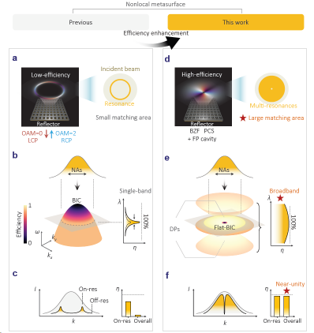
However, previous nonlocal metasurfaces faced a major challenge. Their useful resonances were often too narrow and too dispersive. As a result, only a small portion of the incoming beam could be efficiently converted into a vortex beam. To solve this problem, the authors developed a cavity-assisted reflective nonlocal metasurface. The device combines a silicon photonic crystal slab, a silicon dioxide spacer, and a gold mirror to form a Fabry–Pérot cavity. By coupling bound states in the continuum with degeneracy points, the authors engineered quasi-flat optical bands with strong scattering. This band engineering allows many incident angles and wavelengths to participate in efficient vortex generation at the same time.
The research groups of Prof. Wei Wang from Sichuan University, Prof. Zhanghua Han from Shandong Normal University, and Prof. Lujun Huang from East China Normal University propose a cavity-assisted nonlocal metasurface for broadband, high-efficiency optical vortex generation. The work addresses a long-standing problem in momentum-space metasurfaces: how to keep the advantages of nonlocal, alignment-tolerant wavefront control while greatly improving conversion efficiency and operational bandwidth.
The key idea is to use a Fabry–Pérot cavity as a controllable optical environment that links bound states in the continuum with degeneracy points. These two types of momentum-space singularities both carry useful topological information, but by themselves they do not provide broadband and efficient vortex generation. The authors show that, when they are properly hybridized, the metasurface can simultaneously tune dispersion, radiative quality factor, and polarization state. This creates an “hourglass-shaped” high-efficiency region in momentum space, allowing the device to work over a much broader range of wavelengths and numerical apertures than conventional nonlocal designs.
Numerical simulations predict near-unity on-resonance conversion, more than 90% overall efficiency, and high orbital angular momentum purity. Experiments confirm broadband operation from 1480 to 1600 nm, with a peak overall efficiency approaching 80% and an OAM purity of 91.7%. The device also shows strong robustness against edge effects, incident beam position, beam profile, and numerical aperture. In addition, the authors demonstrate that a zero-order Bessel beam can be converted into a high-quality second-order Bessel vortex beam, also known as a perfect vortex beam.
This technology is well suited for future optical systems that need compact, efficient, and robust vortex generation. Potential applications include high-dimensional optical communications, quantum photonics, optical imaging, beam shaping, and integrated photonic devices. In daily life and society, such advances may eventually contribute to faster data transmission, more capable optical sensors, and more powerful light-based information processing. The next steps may include extending this strategy to the visible spectrum, integrating it with chip-scale photonic platforms, and developing dynamically tunable or multiplexed vortex beam generators. More broadly, this research suggests that momentum-space band engineering can become a practical design principle for next-generation meta-optics.
Keywords: nonlocal metasurfaces; orbital angular momentum; bound states in the continuum; band engineering; broadband operation; vortex beam generation
# # # # # #
Keren Wang: Undergraduate student of the “Qiangji” Class, Class of 2023, College of Physics, Sichuan University (supervised by Professor Wei Wang). Research interests include nanoscale light–matter interactions and momentum-space topological optics. He has published 4 research papers as first/co-first author in journals such as Opto-Electronic Advances, Nature Communications, Nano Letters, and ACS Photonics. He is a recipient of the BYD Scholarship at Sichuan University.
Kaili Sun: Ph.D. graduate, Class of 2026, School of Physics and Electronics, Shandong Normal University (supervised by Professor Zhanghua Han). He will join the National University of Singapore as a postdoctoral researcher (co-supervised by Professor Cheng-Wei Qiu). His research focuses on thermophotonics and nonlinear optics. He has published 20 papers as first author in journals including Nature Communications (4 papers), Newton, Science Advances, and Advanced Photonics. He has received the 2025 China Laser “Qingjin Award” and the 2024 Chinese Optical Society “Wang Daheng Optical Award”.
Lujun Huang: Professor and Ph.D. supervisor at East China Normal University. He focuses on high-quality resonant metasurfaces and has published over 70 papers in journals such as Nat. Rev. Phys., Nat. Commun., Sci. Adv., Phys. Rep., and Opto-Electron. Adv., with over 6000 citations. He received the 2025 Advanced Photonics Innovation Young Scientist Award. He leads a General Program project of the National Natural Science Foundation of China (NSFC) and serves as a youth editorial board member for Advanced Photonics and Opto-Electronic Advances.
Zhanghua Han: Professor and Ph.D. supervisor at Shandong Normal University. He has long been dedicated to the physics and applications of high-Q resonances in nonlocal optical metasurfaces. He has published over 130 papers in journals including Nature Communications, Science Advances, Advanced Photonics, Opto-Electronic Advances, Laser & Photonics Reviews, and Nano Letters, with over 6900 citations and an h-index of 38 (Google Scholar). He has been appointed as “Qianjiang Scholar” Distinguished Professor of Zhejiang Province and “Young Expert” of the Taishan Scholars Program of Shandong Province. He has led four NSFC projects.
Wei Wang: Professor and Ph.D. supervisor at the College of Physics, Sichuan University. His research interests include nanophotonics, metasurfaces, photonic crystals, bound states in the continuum, momentum-space topological optics, and structured light field manipulation. He has published over 60 papers in journals such as Nature Photonics, Nature Communications, and Physical Review Letters, with nearly 2000 citations. He serves as a reviewer for Nature Communications, Advanced Materials, Nano Letters, and other journals, and is an editorial board member of Opto-Electronic Engineering.
# # # # # #
Opto-Electronic Advances (OEA) is a high-impact, open access, peer reviewed SCI journal with an impact factor of 22.4 (Journal Citation Reports 2024). OEA has been indexed in SCI, EI, DOAJ, Scopus, CA and ICI databases, and expanded its Editorial Board to 41 members from 17 countries.
# # # # # #
More information: http://www.oejournal.org/oea
Editorial Board: http://www.oejournal.org/oea/editorialboard/list
All issues available in the online archive (http://www.oejournal.org/oea/archive).
Submissions to OEA may be made using ScholarOne (https://mc03.manuscriptcentral.com/oea).
ISSN: 2096-4579
CN: 51-1781/TN
Contact Us: oea@ioe.ac.cn
Twitter: @OptoElectronAdv (https://twitter.com/OptoElectronAdv?lang=en)
WeChat: OE_Journal
# # # # # #
Wang KR, Sun KL, Du J et al. Cavity-assisted nonlocal metasurfaces for momentum-space broadband-operational optical vortice generation with maximum efficiency approaching 80%. Opto-Electron Adv 9, 250296 (2026). DOI: 10.29026/oea.2026.250296
Opto-Electronic Advances Editorial Office
Opto-Electronic Advances
+86 591 2286 1222
email us here
Legal Disclaimer:
EIN Presswire provides this news content “as is” without warranty of any kind. We do not accept any responsibility or liability
for the accuracy, content, images, videos, licenses, completeness, legality, or reliability of the information contained in this
article. If you have any complaints or copyright issues related to this article, kindly contact the author above.

Media gallery