

Nanjing, Jiangsu, China – November 23, 2026
Warehouse Robot tech is changing the way global buyers move, store, and retrieve goods—and it’s changing fast. Today’s strongest manufacturers don’t just sell one machine; they bring together mobile robots, automated storage systems, robotic arms, and smart software. But here’s the catch: product names can make very different systems sound almost the same. A robot that looks quick in a demo might still struggle with uneven floors, cartons that keep changing size, or crowded picking aisles.Raffaello D’Andrea—robotics professor and Kiva Systems co-founder—put it well: “The goal is to make people more effective, not to replace them.” That idea still holds up. Buyers should look at Amazon Robotics, Daifuku, AutoStore, Ocado, Geek+, and GreyOrange under real operating conditions, not just on a showroom floor. Warehouse Robot performance comes down to payload, navigation accuracy, charging time, software integration, and service support. A polished demo? Not enough. Look beyond speed.This guide compares leading Warehouse Robot manufacturers for global buyers. It looks at warehouse size, labor patterns, product variety, safety systems, and expansion plans. It also digs into deployment experience, system reliability, spare-parts access, and how well everything connects with warehouse management software. Those details often decide whether the investment actually pays off.There’s no perfect supplier. One company might have excellent robots but weaker local support. Another might offer flexible software but charge more for installation. So buyers should ask for site references, maintenance records, pilot results, and clear performance targets. They should also test for seasonal demand, damaged packaging, and unexpected aisle obstructions.Some evaluations will always be imperfect. Public rankings rarely show every failure rate or service limitation. That’s why this overview sticks to practical criteria instead of promotional claims. The best choice isn’t always the most famous manufacturer. It’s the partner that fits the warehouse, the workforce, the budget, and the long-term operating reality.
 Types of Warehouse Robots Used in Modern Logistics
Modern logistics uses several warehouse robot types, each solving a different movement problem.
Autonomous mobile robots carry shelves, totes, or cartons across changing routes. Automated guided vehicles follow fixed paths, magnetic lines, or floor markers. They remain useful where traffic patterns rarely change. Robotic arms handle palletizing, depalletizing, picking, and case packing. Shuttle systems and robotic storage units retrieve bins from dense racks. Drones may support cycle counting, although their value depends on ceiling height and inventory accuracy.
IFR’s World Robotics 2024 report recorded about 113,000 professional transportation and logistics robots sold in 2023, showing strong operational demand.
Selection should begin with workflow data, not attractive demonstrations.
A warehouse processing small, mixed orders may need picking robots and vision systems. A beverage facility may gain more from pallet movers and automated storage.
Interact Analysis has identified mobile robots as a rapidly expanding warehouse automation segment, but growth does not remove integration risks.
Poorly mapped aisles create delays. Weak battery planning creates idle equipment.
Rgv Robot evaluations should compare payload, turning radius, charging time, safety controls, and software compatibility.
The fastest machine is not always the most productive.
Tips:
Measure walking distance before choosing a robot type. Test peak-hour traffic, not quiet shifts. Keep one manual fallback during early deployment. Review exception handling weekly.
Some pilot results look impressive, yet labor savings remain uncertain when replenishment tasks are ignored. That mistake deserves honest review.
Key Criteria for Evaluating Warehouse Robot Manufacturers
Choosing warehouse robot manufacturers requires more than comparing prices or advertised payloads. Evaluate proven experience in warehouses like yours, including aisle width, floor quality, temperature, and daily order volume. A Shuttle Robot should move smoothly under full load, stop accurately, and recover safely after interruptions. Ask for test data, maintenance records, and customer references from similar operations.Technical expertise matters during integration. Check whether the manufacturer supports warehouse management systems, barcode equipment, fleet software, and future expansion. Request clear details about battery life, charging time, spare parts, software updates, and technician response times. Reliable suppliers explain limitations openly. They should also provide safety documentation, operator training, risk assessments, and compliance evidence for your market.Tips: Watch a live demonstration with mixed-size cartons, not only ideal loads. Measure recovery time after a blocked route. Inspect the service process, because a robot can become expensive when support is slow. No scorecard is perfect. A supplier may perform well in testing but struggle during seasonal peaks. Leave room for a monitored pilot, measurable acceptance targets, and honest feedback from warehouse workers. Their daily observations often reveal noise, awkward interfaces, or delays that technical brochures miss.
Key Criteria for Evaluating Warehouse Robot Manufacturers
Reference weighting for global buyer evaluations. The percentages represent normalized purchasing priorities rather than the performance of any specific company or brand.
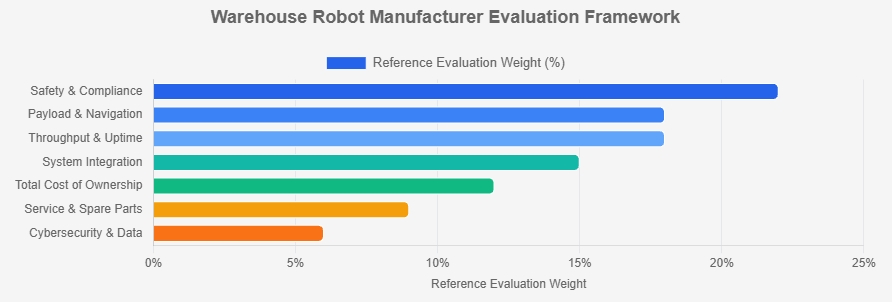
Safety compliance and operational performance should be assessed first, followed by integration capability, lifecycle cost, and after-sales support. Buyers should validate each criterion using product documentation, site tests, reference projects, and contractual service-level agreements.
Leading Warehouse Robot Manufacturers for Global BuyersLeading Warehouse Robot Manufacturers for Global Buyers
Global buyers are expanding warehouse automation, but supplier selection requires more than impressive demonstrations. The International Federation of Robotics reported 541,302 industrial robots installed worldwide in 2023. Although warehouse robots form a separate category, this figure confirms wider confidence in automated material handling. Interact Analysis also identifies mobile robots as a fast-growing segment, driven by labor shortages, e-commerce, and flexible fulfillment requirements.
Leading warehouse robot manufacturers should provide measurable performance, not vague promises. Buyers should examine payload accuracy, navigation stability, battery endurance, fleet-management software, and recovery procedures. A robot moving 600 totes per hour may perform differently in narrow aisles, cold storage, or dusty environments. Request site references and independent acceptance-test results. Check integration with warehouse-management and warehouse-control systems. Compatibility matters.
The shortlist is never perfect. A lower purchase price can hide integration costs, training needs, and delayed maintenance support. The 2024 MHI Annual Industry Report shows that supply-chain organizations continue increasing investment in automation and digital technologies. That investment still requires disciplined validation. Ask manufacturers for uptime data, mean time between failures, cybersecurity controls, spare-parts availability, and regional service coverage. Pilot testing should measure real order profiles, walking distances, exception rates, and worker interaction. Small details decide large outcomes.
Core Technologies Behind Warehouse Automation Systems
Modern warehouses depend on more than fast machines and attractive specifications. Reliable automation connects mobile robots, robotic arms, sensors, software, and trained operators. The details matter. A Robot Palletizer must recognize different carton sizes, maintain stable stacking patterns, and communicate with warehouse control software. Vision cameras inspect labels and pallet positions before each movement. Force sensors help detect uneven loads or unexpected resistance.
Core automation systems usually combine autonomous mobile robots, conveyor controls, and warehouse management platforms. Fleet software assigns routes while avoiding congestion near loading docks. Safety scanners slow or stop machines when people enter restricted areas. Battery management also matters during long shifts. A robot that pauses at 3 p.m. can disrupt an entire shipping schedule. Practical testing should measure cycle time, recovery speed, noise, and maintenance access. Laboratory performance can look excellent.
Global buyers should examine integration records, operator training, spare-part support, and cybersecurity practices. Ask manufacturers to demonstrate failure recovery, not only normal operation. A carton may tilt, a barcode may blur, or a pallet may arrive damaged. Systems need clear responses. No system is perfect. Even experienced engineering teams can underestimate floor conditions, seasonal demand, or workers’ habits. A controlled pilot with real cartons often reveals more than a polished presentation. That evidence supports safer investment decisions across different warehouse environments.
Comparing Robot Performance, Costs, and Integration Requirements
Global buyers should compare warehouse robots through measurable operating conditions, not impressive demonstrations.Key indicators include picks per hour, navigation accuracy, battery endurance, and recovery time after an obstruction. Speed alone misleads. A robot moving quickly may still reduce output when scanners miss labels or aisles become crowded.
A Shuttle Carrier Robot can deliver high throughput in dense storage, but its value depends on rack design, pallet dimensions, and lift precision. Buyers should examine total costs, including software licenses, charging equipment, spare parts, installation, and technician training. A lower purchase price may hide expensive integration work. Request performance data from warehouses with similar temperatures, floor quality, and order profiles. Otherwise, comparisons remain weak.
Integration often requires warehouse management system connections, safety mapping, network upgrades, and clear human-robot traffic rules. Test a limited zone before approving a full deployment. Measure real orders during peak shifts, not only clean trial runs. Ask how faults are logged and how quickly remote support responds. The difficult part is predicting change. Product sizes, labor patterns, and storage layouts rarely stay fixed. A careful buyer should leave capacity for software updates and imperfect assumptions. That caution is practical, not pessimistic.
Selecting the Right Warehouse Robot Supplier for Different OperationsTop Warehouse Robot Manufacturers for Global Buyers
Selecting a warehouse robot supplier starts with the operation, not the machine. A compact fulfillment center may need autonomous mobile robots for short picking routes. A cold-storage facility requires sealed components, stable batteries, and reliable performance below zero. Heavy pallet movement demands stronger lifting capacity, wider aisles, and accurate braking. Match the robot to actual loads, floor conditions, shift patterns, and order volume.
Ask suppliers to provide measurable performance data from similar facilities. Check payload limits, average travel speed, charging time, navigation accuracy, and uptime under continuous use. Request a live demonstration with your cartons, shelving, and floor markings. Integration also matters. The system should communicate smoothly with warehouse management and inventory software. Poor integration can create delays, even when the robot itself performs well.
Service capability often separates a dependable supplier from a cheaper option. Review spare-part availability, remote diagnostics, technician response times, training, and software update procedures. Confirm safety testing and local compliance before signing a contract. I have seen projects underestimate aisle congestion and battery recovery time. That mistake is expensive. A pilot program can expose these weaknesses early, although pilot results may not represent peak-season pressure. Ask for transparent pricing, realistic installation schedules, and clear responsibility when performance falls short.
Conclusion
Modern logistics relies on a wide range of warehouse robots, including autonomous mobile robots, automated guided vehicles, robotic arms, sorting systems, and pallet-handling machines. This article explains how these technologies support transportation, picking, packing, sorting, storage, and inventory management. It also introduces the key factors global buyers should consider when evaluating manufacturers, such as product reliability, payload capacity, navigation accuracy, software capabilities, safety design, scalability, after-sales support, and compliance with local requirements.The guide compares Warehouse Robot performance, operating costs, maintenance needs, deployment time, and integration requirements with existing warehouse management systems. It explores the core technologies behind automation, including sensors, artificial intelligence, cloud platforms, fleet management, and real-time data analysis. Finally, it provides practical guidance for selecting the right supplier according to warehouse size, product type, workflow complexity, labor structure, and future expansion plans, helping businesses make informed and efficient automation decisions.
About Us
EBILTECH (Jiangsu Ebil Intelligent Storage Technology Co., Ltd.) is a leading high-density intelligent warehousing solution provider and warehouse equipment manufacturer in China, certified as a national high-tech and specialized innovative enterprise. We offer one-stop services including intelligent warehouse design, automated warehouse equipment manufacturing, warehouse software development, AS/RS project integration and global after-sales maintenance.
Media Contact
Company Name: Jiangsu EBIL Intelligent Storage Technology Co., Ltd.
Contact Person: Media Relations
Email: Send Email
Country: China
Website: https://www.ebilstorage.com/
Press Release Distributed by ABNewswire.com
To view the original version on ABNewswire visit: EBILTECH Releases Comprehensive Guide Highlighting Top Warehouse Robot Manufacturers for Global Buyers
Media gallery
