Global Latex and Occupational Allergy Market Poised for Significant Shift Toward Synthetic Solutions Through 2036
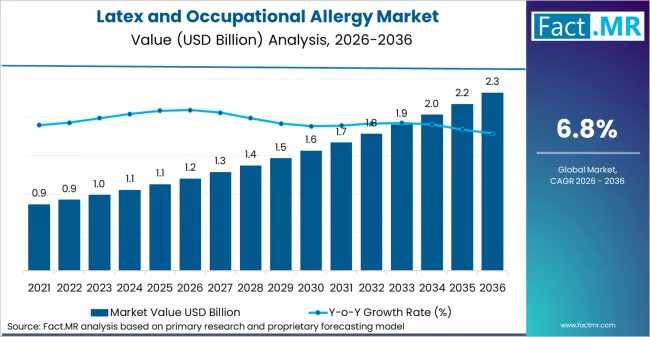
UNITED STATES, MD, UNITED STATES, January 29, 2026 /EINPresswire.com/ — Latex and Occupational Allergy Market : The global latex allergy market is undergoing a fundamental transformation as industrial safety standards and healthcare protocols pivot toward synthetic, hypoallergenic alternatives. Valued at $1.83 billion in 2026, the market is projected to reach $3.5 billion by 2036, expanding at a compound annual growth rate (CAGR) of 7.5%. This growth is driven by a critical need to mitigate occupational health risks and the rising prevalence of latex sensitization among high-risk professionals.
Request for Sample Report | Customize Report |purchase Full Report – https://www.factmr.com/connectus/sample?flag=S&rep_id=13971
As industries worldwide prioritize worker longevity and safety, the “”Who, What, and Why”” of this market shift have become clear:
Who: Healthcare professionals, rubber industry workers, and food service personnel remain the primary demographic at risk, with an estimated 8% to 17% of healthcare workers currently sensitized to latex proteins.
What: A comprehensive move away from Natural Rubber Latex (NRL) toward nitrile, neoprene, and other advanced synthetic polymers.
When: The transition is accelerating in 2026 as regulatory bodies tighten workplace safety mandates.
Where: While North America remains the largest market by value, the Asia-Pacific region is the fastest-growing sector due to rapid healthcare infrastructure expansion.
Why: Occupational allergies, particularly contact dermatitis and asthma, account for nearly $1 billion annually in lost productivity and medical costs in the U.S. alone.
The Economic and Clinical Burden of Occupational Allergies
Occupational allergies are no longer viewed merely as individual health concerns but as significant systemic liabilities. Recent data suggests that contact dermatitis is the second most common occupational illness globally. In highly exposed environments, such as surgical suites and manufacturing plants, the aerosolization of latex proteins via glove powder has been linked to an increase in work-related rhinitis and asthma.
“”The shift to latex-free environments is no longer elective; it is a clinical and economic necessity,”” states the latest industry analysis. “”By adopting synthetic alternatives, organizations are not only protecting staff but also reducing the high costs associated with absenteeism and workers’ compensation.””
Market Segmentation and Key Growth Drivers
The market is diversifying into three primary segments: diagnostics, therapeutics, and preventative equipment.
Segment Primary Driver Market Outlook
Diagnostics Rise in in-vitro (IVD) testing and skin prick tests. High demand for early screening.
PPE (Gloves/Tools) Transition to nitrile and powder-free synthetics. Largest revenue share of the market.
Therapeutics Increased use of epinephrine and immunotherapy. Rapid growth in systemic reaction management.
Innovation and Competitive Landscape
Key industry players, including Ansell Ltd., 3M, Cardinal Health, and Hartalega Holdings, are investing heavily in R&D to close the performance gap between natural latex and synthetic substitutes. New “”polyisoprene”” technologies now offer the tactile sensitivity of natural rubber without the allergenic proteins (Hev b 1 to Hev b 13) responsible for Type I hypersensitivity.
Furthermore, the integration of Artificial Intelligence (AI) in allergy diagnostics is streamlining the identification of sensitized individuals, allowing for proactive workplace reassignments before chronic symptoms develop.
Future Outlook: A “”Latex-Safe”” Global Standard
Looking toward 2030, the market is expected to move beyond “”latex-free”” to “”biocompatible”” standards. This includes the development of plant-based, non-rubber alternatives that address both human health and environmental sustainability. As e-commerce channels expand access to these specialized products, the barrier to entry for smaller clinics and industrial sites continues to fall, further fueling global market penetration.
About This Market Intelligence Report
This press release summarizes recent findings in occupational health and global medical supply trends. It is intended for industry analysts, healthcare administrators, and investors monitoring the intersection of material science and workplace safety.
To View Related Report :
Hand Hygiene Soaps and Sanitizers Additives Market https://www.factmr.com/report/hand-hygiene-soaps-and-sanitizers-additives-market
Hand Hygiene Monitoring System Market https://www.factmr.com/report/2277/hand-hygiene-monitoring-system-market
Handheld Marijuana Medical Vaporizer Market https://www.factmr.com/report/handheld-marijuana-medical-vaporizer-market
Handheld Fluorescence Imaging Devices Market https://www.factmr.com/report/5266/handheld-fluorescence-imaging-devices-market
S. N. Jha
Fact.MR
+ +1 628-251-1583
email us here
Legal Disclaimer:
EIN Presswire provides this news content “as is” without warranty of any kind. We do not accept any responsibility or liability
for the accuracy, content, images, videos, licenses, completeness, legality, or reliability of the information contained in this
article. If you have any complaints or copyright issues related to this article, kindly contact the author above.