HUSTON, TX, UNITED STATES, November 3, 2026 /EINPresswire.com/ — Merely confirming protein presence is insufficient; biological activity defines functional performance. A protein may remain chemically detectable yet lose its biological function once its three-dimensional conformation collapses, much like a worn-out key that can no longer turn a lock. Many researchers face recurring practical questions: What exactly is protein biological activity? What categories does it fall into? Which assays should be adopted for validation? How many activity read-outs are required to qualify a protein product? This article unpacks the functional logic behind bio-active proteins to support reliable experimental design for global research communities.
Why Biological Activity Represents the Core of Bio-Active Proteins
Protein biological activity describes the specific biological functions executed by a protein molecule, which strictly depend on its precise three-dimensional conformation. Folding of amino-acid sequences generates functional domains responsible for target recognition, biochemical catalysis and cellular-signal transduction.
Protein detection does not equal protein activity. Western Blot can confirm that target protein exists within a sample. However, high temperature, extreme pH and other stress conditions trigger protein denaturation and conformational breakdown. Even if distinct protein bands can still be visualised, biological function may be completely abolished. Consequently, the core value of bio-active proteins lies in verifiable biological functionality.
In broad terms, protein activity encompasses molecular-level binding capacity, catalytic performance and cell-regulatory effects. In day-to-day laboratory practice, “protein-activity testing” specifically refers to functional assays that verify whether a protein exerts its expected biological roles.
Three Major Categories of Protein Biological Activity
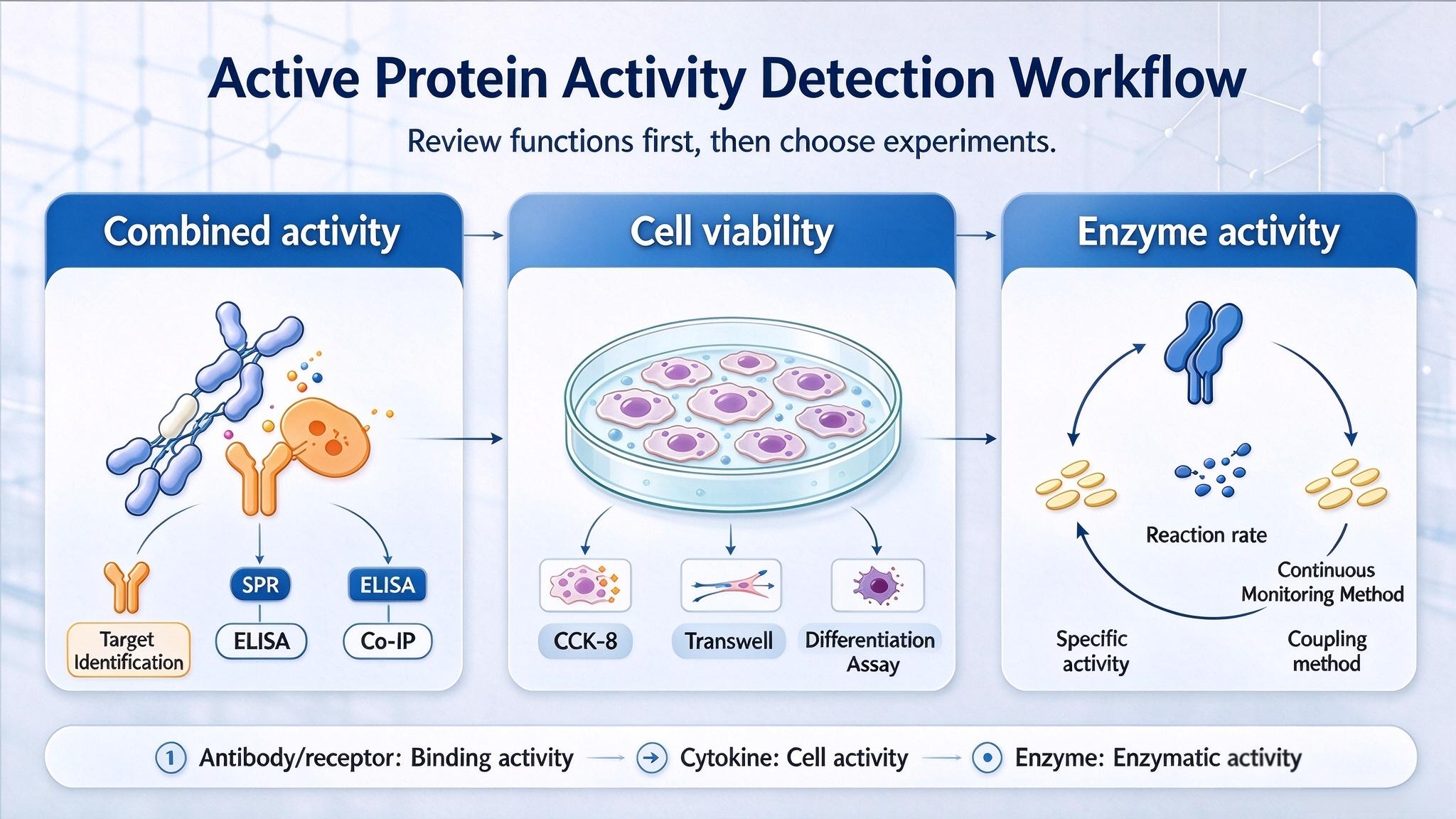
Based on functional characteristics, protein activity can be grouped into binding activity, cellular activity and enzymatic activity.
1. Binding Activity
Binding activity addresses the core question: Can this protein recognise its intended target? It serves as the initial step for most protein-mediated biological events. Antigen-antibody recognition, receptor-ligand interaction and transcription-factor-DNA binding all belong to this category. For antibodies and receptors whose primary function is molecular recognition, binding activity largely accounts for their full biological performance.
2. Cellular Activity
Cellular activity answers the question: Can this protein trigger measurable cellular responses? It delivers read-outs that closely mirror physiological conditions. Observed outcomes include cell proliferation, differentiation, migration suppression or promotion, and apoptosis induction. For cytokines, growth factors and chemokines, cellular-level responses represent the ultimate manifestation of protein function.
3. Enzymatic Activity
Enzymatic activity evaluates how rapidly an enzyme drives its biochemical reaction. Catalytic capability defines the functional performance of enzymes. Enzymatic activity is commonly reported as specific activity, defined as enzyme-activity units per unit mass of protein. For catalytic proteins such as SOD, proteases and kinases, enzymatic-activity measurement acts as the primary quality metric.
Figure 1. Workflow for bio-active protein activity assessment: define biological function first before selecting appropriate experimental assays
Assay Methods for Each Type of Protein Activity
Different protein-activity categories correspond to distinct characterisation workflows.
Assays for Binding Activity
Functional binding ELISA: A widely used high-throughput screening tool. Target molecules are immobilised on microplate wells; test protein samples are applied, and binding events are quantified via colorimetric signals. This approach features simple workflows and high sample throughput.
Surface Plasmon Resonance (SPR): Gold-standard technique for binding-activity validation. It enables label-free, real-time monitoring of molecular interactions and yields critical parameters including association rate, dissociation rate and equilibrium dissociation constant (KD). Lower KD values correspond to stronger binding affinity.
Co-immunoprecipitation (Co-IP): Used to verify protein-protein interactions under native intracellular conditions.
Isothermal Titration Calorimetry (ITC): Measures heat exchange during molecular binding to calculate binding affinity and key thermodynamic parameters.
Figure 2. Functional binding ELISA measurement of recombinant human CLEC3B protein binding activity
Assays for Cellular Activity
– Proliferation assays (CCK-8 / MTT / EdU): Quantify protein-driven cell division and population expansion. – Cytotoxicity assays (LDH / Annexin V-PI staining): Assess protein-mediated target-cell killing or growth-suppression effects. – Cell-differentiation assays: Judge protein-induced stem-cell fate conversion via morphological observation or differentiation-marker detection. – Migration and chemotaxis assays (Transwell / scratch-wound assay): Evaluate protein-dependent modulation of cellular motility and chemotactic responses.
Figure 3. Chemotactic-activity assessment of recombinant rat MCP1 towards THP-1 cells using the Transwell migration assay
Assays for Enzymatic Activity
– Colorimetric and fluorometric assays: Measure reaction rates through optical-signal shifts of substrates and reaction products. – Continuous-monitoring assay: Track absorbance changes in real-time throughout enzymatic reactions to generate kinetic rate curves. – Coupled enzymatic assay: Couple the target enzymatic reaction to a secondary signal-generating enzymatic reaction for indirect activity quantification.
Selecting Suitable Activity Assays for Target Proteins
The core guiding principle is to base assay selection on the native biological function of the protein of interest.
1.Antibodies, receptors and ligands: Prioritise binding-activity assays; molecular recognition constitutes their core physiological role.
2.Cytokines, growth factors and chemokines: Prioritise cellular-activity assays, as their function manifests through altered cellular behaviours.
3.Enzymes (SOD, proteases, kinases and others): Prioritise enzymatic-activity assays; catalytic performance is their primary function.
4.Hormonal proteins: Generally combine cellular-activity assays as the primary read-out with supplementary binding-activity characterisation. For instance, the core physiological effect of insulin must be validated at cellular or in-vivo animal levels.
Two additional practical dimensions support decision-making: – Product datasheet reference: Reputable suppliers publish validated activity-characterisation datasets for bio-active protein products. For example, Cloud-Clone’s SIRT3 active protein (Cat.No. APE913Ra01) includes SPR binding-assay data within supporting documentation to demonstrate suitability for binding-interaction studies. – Research objectives: SPR or equivalent binding assays are appropriate for investigations focused on small-molecule-target interactions. Cellular-activity assays are required for studies exploring protein-driven functional changes in target cells.
How Many Activity Assays Should Be Performed for a Bio-Active Protein?
No universal standard exists; testing scope is determined by protein category and downstream application scenarios.
Scenario 1: Single-activity validation – Enzymes: Enzymatic-activity measurement alone is typically sufficient, e.g. SOD activity testing. – Therapeutic-antibody candidates: Binding-activity serves as the primary quality metric.
Scenario 2: Two complementary activity read-outs – Cytokines / growth factors: Cellular-activity as primary evidence, supplemented by binding-activity data to support mechanistic interpretation. – Receptors / ligands: Binding-activity as primary characterisation, complemented by cellular-activity testing.
Scenario 3: Full three-category activity profiling This comprehensive characterisation is relatively uncommon and mostly reserved for complete pre-clinical profiling of novel recombinant-protein drug candidates. A new protein therapeutic may undergo binding-activity testing (target engagement), cellular-activity testing (functional cellular response), plus enzymatic-activity assays (if catalytic function is present), to achieve full functional documentation.
For biopharmaceutical batch-release quality control, manufacturers select assays that best represent the protein’s core physiological function as release specifications. As an example, interferon-γ batch release commonly adopts cellular-activity assays (such as induction of morphological shifts in THP-1 cells), reflecting its antiviral and immunomodulatory biological roles.
Biological activity defines the functional value of bio-active proteins. Distinguishing between binding, cellular and enzymatic-activity profiles, mastering corresponding characterisation techniques, and designing validation workflows aligned with native protein physiology form essential expertise for researchers in life-science and biomedical fields.
When sourcing bio-active protein reagents, researchers should prioritise traceable activity data, consistent batch-to-batch performance and comprehensive technical support. Only rigorously validated proteins can deliver stable, reproducible experimental outcomes.
As recombinant-protein-based research and therapeutic development expand globally, robust functional characterisation remains critical to minimise experimental variability and accelerate translational research. Cloud-Clone continues to implement comprehensive multi-dimensional activity-validation workflows for its bio-active-protein portfolio, delivering well-annotated reagents to empower worldwide fundamental biomedical study and therapeutic-candidate development.
SuKi Duan
CLOUD-CLONE CORP.WUHAN
Visit us on social media:
LinkedIn
Instagram
TikTok
X
Legal Disclaimer:
EIN Presswire provides this news content “as is” without warranty of any kind. We do not accept any responsibility or liability
for the accuracy, content, images, videos, licenses, completeness, legality, or reliability of the information contained in this
article. If you have any complaints or copyright issues related to this article, kindly contact the author above.

Media gallery