
If you’ve used a large language model such as ChatGPT, you’ve interacted with a transformer, the neural network architecture that powers many generative artificial intelligence (AI) models.
This press release features multimedia. View the full release here: https://www.businesswire.com/news/home/20260727158312/en/
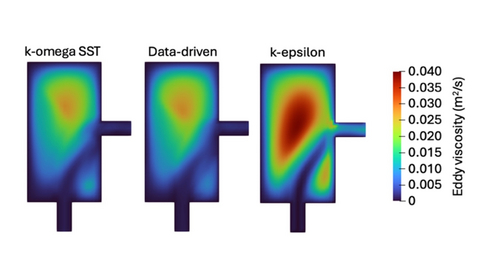
Turbulent viscosity fields predicted by data-driven model and two standard approaches (k-omega SST and k-epsilon). (Image by Argonne National Laboratory)
Researchers at the U.S. Department of Energy’s Argonne National Laboratory are adapting this architecture to model complex physical systems. They’re using AI transformers to accelerate and improve fluid-dynamics simulations for advanced nuclear reactors. Better simulations strengthen nuclear energy systems, keeping them safe and efficient.
Argonne’s transformers analyze the relationship between physical data, such as locations, velocities and how fluids flow within a nuclear power plant. Predicting the effects of fluid flows is called turbulence modeling.
The researchers are adding transformer architectures into the System Analysis Module (SAM). SAM is a tool developed at Argonne for studying advanced nuclear reactors. By combining transformer-based AI with turbulence modeling, the team aims to improve SAM’s ability to show complex fluid-dynamic behavior.
“With AI, we can be as accurate as the complex methods and as fast as the simple methods,” said Rui Hu, principle nuclear engineer and manager of the Safety and Engineering Analysis Department in Argonne’s Nuclear Science and Engineering Division (NSED). “It is a union of accuracy and speed.”
AI-based models can deliver results almost instantaneously while keeping the accuracy of more complex methods.
The new Argonne model in SAM has demonstrated high accuracy in representing the resistance of fluid to flow and how heat moves through it. The ability to capture these features is key to reliable turbulence modeling.
This advancement lets researchers conduct more realistic simulations. These can help improve reactor design, performance and safety. Next, the team plans to use the model to simulate entire power plants, including reactors, supporting components, and cooling, safety and auxiliary systems.
The team is also exploring the use of digital twins, or virtual models of physical systems operating in real time. They are among the first to apply transformer architectures to digital twin technology for nuclear systems. Future research will focus on expanding these models, improving their accuracy and flexibility, and integrating new AI-enabled models into SAM’s simulation workflow.
By using advanced AI, Argonne is driving faster, more accurate simulations that support the safe and efficient operation of nuclear energy systems.
This work is supported by the Department of Energy’s Nuclear Energy Advanced Modeling and Simulation (NEAMS) Program.
View source version on businesswire.com: https://www.businesswire.com/news/home/20260727158312/en/
Media gallery


