
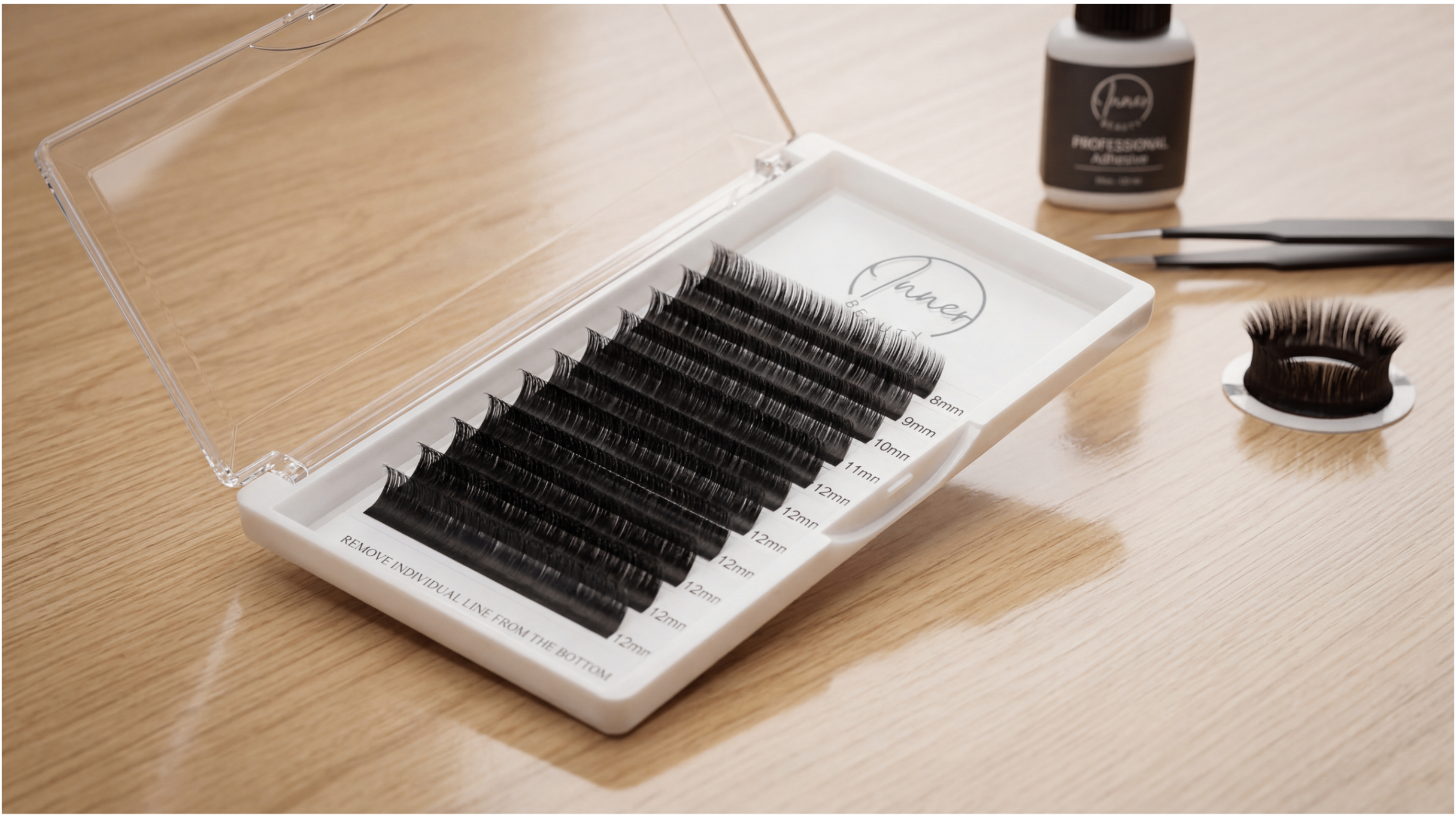
Ask a room of lash artists what they pay per tray, and you’ll get answers between four dollars and thirty. Ask what they pay per set and the room goes quiet — because most of us have never actually run the number.
That’s the number that decides whether your pricing works.
Tray price is the wrong metric
A tray is inventory. A set is the unit you sell. The gap between those two things is where lash businesses quietly lose margin, and it’s why the cheapest tray on a marketplace listing is not automatically the cheapest way to fill a chair.
Here’s the arithmetic:
Lash cost per set = (tray price ÷ usable lashes per tray) × lashes used per set
For a classic full set, most artists apply somewhere between 300 and 400 extensions across both eyes. Volume sets use fewer natural-lash attachment points but far more extensions — a 4D fan set can run 1,200 or more.
Say a tray holds 4,000 lashes and costs $8. That’s $0.002 per lash, or roughly $0.70 in lash cost for a 350-extension classic set.
Now run the same math on a $20 tray: about $1.75 per set. On a hundred sets a year, that’s a hundred dollars. Real, but probably not the thing keeping you up at night.
So why does supplier choice matter so much? Because tray price is the smallest line in the equation.
The costs that don’t show up on the price tag
Usable lashes, not total lashes. A tray advertising 4,000 lashes across sixteen rows only helps if you use those lengths. Single-length trays in a length you rarely map are shelf decoration. Mixed trays waste less, but only if the distribution matches how you actually lash. Every row you don’t use inflates your true cost per set — sometimes by half again.
Minimum order quantities. Plenty of wholesale programs require ten or more trays per variant before they’ll quote you a price. If you need four curls in three diameters, a “minimum ten per type” policy means committing to over a hundred trays to stock your basics. That’s not a discount. That’s a loan you made to your supplier.
Production lead times. Two- to three-week production windows are common on wholesale lash orders. If you run out of your workhorse 0.07 C curl mid-month, a three-week lead time means either turning away bookings or buying a stopgap tray at retail — which erases the wholesale saving entirely.
Inconsistency. This is the expensive one. When taper or curl varies between lots, you find out mid-appointment. The set takes longer. Retention complaints go up. You do a free fill to keep a client who was going to refer three more. A single redo appointment costs more in chair time than a year of tray-price difference.
That last one is why “who made this” matters more than “what does it cost.” Marketplace lash trays are frequently sourced through resellers, and a listing that looks identical month to month may not be the same product month to month.
What to ask before you commit to a supplier
Run any new supplier through this before you stock up:
- Do you manufacture this, or resell it? Resellers can’t guarantee lot consistency because they don’t control production.
- What’s the minimum order? If there is one, calculate the total capital required to stock your actual working range, not the price of one tray.
- How many rows and what’s the length distribution? Then map it against the lengths you genuinely use.
- What’s the lead time when something’s out of stock?
- Can I try one before I commit? A supplier confident in the product will let you work with it first.
- How long have you been making this? Longevity isn’t everything, but a manufacturer that’s survived a decade of lash artists’ opinions has been corrected a lot of times.
The honest version of where we land
We manufacture our own lash extensions and have since 2016 — for the first ten years, sold in person only, to artists who could pick up a tray and look at it under a lamp before buying.
Pro Access, our wholesale tier, is $8 a tray with no order minimums. The no-minimum part is deliberate: we’d rather you buy four trays in the exact curls and diameters you map with than a hundred you’re stuck with. Classic and volume, full range of curls, diameters, and lengths, shipped from Washington state.
And your first tray is free — you pay $5 shipping.
That offer exists for one reason. Switching lash suppliers is a genuine risk when you have clients booked. Nobody should take our word for taper and consistency. Work with a tray, put it on a real client, and decide.
InnerBeauty Lashes
2817 Wetmore Ave
#2B
Everett
WA
98201
United States


