Tea Market Research Report Information by Type, Form, Flavor, Distribution Channel, and Region Forecast to 2035
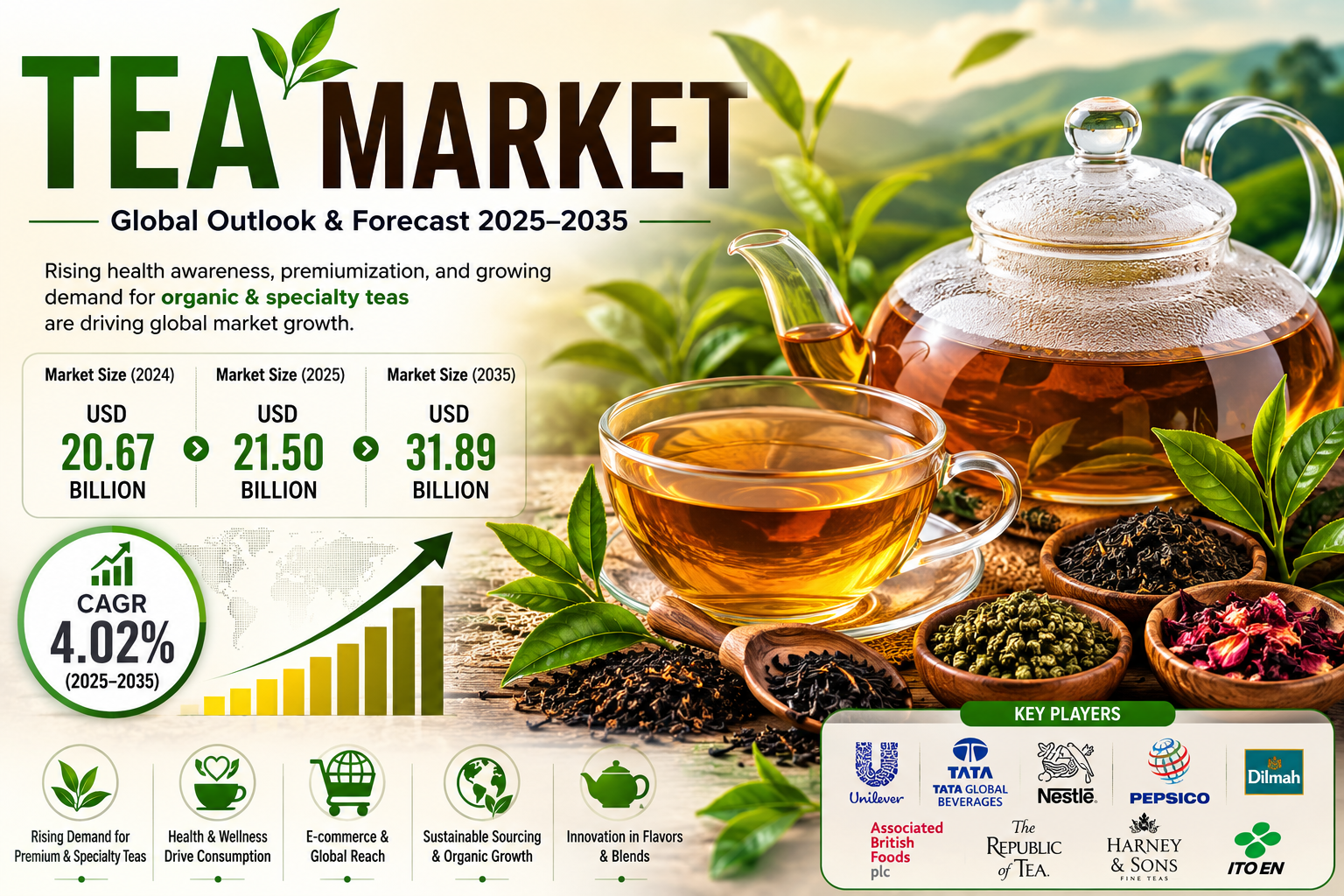
NEW YORK, NY, UNITED STATES, June 17, 2026 /EINPresswire.com/ — The global Tea Market continues to demonstrate steady expansion as consumers increasingly embrace premium tea varieties, organic formulations, wellness-focused beverages, and specialty blends. According to the latest industry analysis published by Market Research Future, the Tea Market was valued at USD 20.67 billion in 2024 and is estimated to reach USD 21.50 billion in 2025. The market is projected to grow significantly and attain USD 31.89 billion by 2035, registering a compound annual growth rate (CAGR) of 4.02% during the forecast period from 2025 to 2035.
Tea remains one of the world’s most consumed beverages after water, serving as a cultural cornerstone across Asia, Europe, the Middle East, and increasingly across North and South America. As consumer palates evolve, preferences are shifting from conventional commodity teas toward premium, specialty, and wellness-oriented offerings. This shift is transforming the tea industry from a volume-driven commodity trade into a high-value, diversified consumer goods sector.
Market Dynamics and Key Drivers
The global tea market is being propelled by a powerful convergence of health consciousness, premiumization, and the proliferation of specialty beverage culture. Consumers across demographics are increasingly recognizing tea as a functional beverage that delivers antioxidants, polyphenols, L-theanine, and other bioactive compounds linked to improved cognitive function, immune support, cardiovascular health, and stress management.
The rising consumer preference for premium and organic tea products is one of the most influential market dynamics identified in this report. Organic certification, single-origin sourcing, and artisanal blending are no longer niche propositions but are now firmly embedded in mainstream retail and foodservice. Consumers—particularly millennials and Generation Z—are willing to pay a significant price premium for teas that carry sustainability credentials, transparent supply chains, and unique flavor profiles.
The global wellness movement continues to serve as a primary engine for market growth. The proliferation of herbal, green, white, and Oolong teas positioned around specific wellness outcomes such as sleep enhancement, detoxification, weight management, and immunity has opened entirely new consumer segments. Functional tea infusions incorporating adaptogens, probiotics, and botanicals are growing rapidly in developed markets across North America and Europe.
Expanding urbanization and the growing café culture, particularly in Asia-Pacific markets such as China, India, and Japan, are further amplifying demand. The emergence of specialty tea cafés, tea bars, and premium blending studios mirrors a trend that coffee experienced a decade earlier, suggesting that the industry is entering a new phase of premiumization.
Get Full PDF Sample Copy of Report: (Including Full TOC, List of Tables & Figures, Chart) @ https://www.marketresearchfuture.com/sample_request/2155
Key Market Opportunities
Among the most significant market opportunities identified in this report is the growing consumer preference for organic and specialty teas, which presents a highly lucrative growth avenue. As regulatory bodies in North America, Europe, and parts of Asia strengthen organic certification frameworks, the credibility and consumer trust associated with certified organic tea products continues to rise. This creates favorable conditions for both established brands and emerging specialty players.
The rapid growth of e-commerce and direct-to-consumer (D2C) sales channels presents another transformative opportunity. Online platforms enable tea brands to reach niche global audiences, offer subscription models, and gather first-party data for product personalization—advantages that are particularly valuable in a fragmented market. Social media platforms have also become critical discovery channels for specialty tea brands, driving virality around limited-edition single-origin teas, ceremonial matcha, and artisan blends.
The ready-to-drink (RTD) tea segment continues to exhibit strong performance as a bridge between health-conscious consumers and the convenience economy. Cold brew teas, sparkling tea beverages, kombucha hybrids, and functional RTD formats are gaining traction in modern trade, convenience channels, and quick-service restaurants globally. Innovations in natural sweeteners and clean-label formulations are reducing barriers to purchase among health-conscious consumers who previously avoided RTD teas due to added sugar content.
The Middle East and Africa (MEA) and Latin American regions, while currently smaller contributors, represent high-potential growth frontiers. Rising disposable incomes, expanding middle-class populations, and increasing exposure to global beverage trends through digital media are creating favorable demand environments in these geographies.
Competitive Landscape
The global tea market features a highly competitive and fragmented landscape with both multinational corporations and regional specialty players vying for market share. Key companies profiled in this report include Unilever (GB), Tata Global Beverages (IN), Nestle (CH), PepsiCo (US), Dilmah (LK), Associated British Foods (GB), The Republic of Tea (US), Harney & Sons (US), and Ito En (JP).
Unilever, through its Lipton and PG Tips brands, holds one of the largest global market shares, leveraging extensive distribution networks and strong brand equity across mainstream tea segments. Tata Global Beverages, operating through the Tetley and Tata Tea brands, commands significant market presence in South Asia, the United Kingdom, and select North American markets, with increasing investments in premium and specialty lines.
Ito En of Japan is a dominant force in the RTD green tea segment and has been expanding its international reach through the growing global interest in Japanese tea culture, particularly matcha and Sencha. Dilmah of Sri Lanka differentiates through its premium single-origin positioning, ethical sourcing commitments, and strong branding around Ceylon tea heritage.
Harney & Sons and The Republic of Tea represent the premium specialty tier in the U.S. market, competing on artisanal quality, unique blends, and experiential retail. These brands are benefiting from the accelerating premiumization trend as consumers seek elevated, story-driven tea experiences.
Competitive strategies across the industry encompass product innovation in functional and wellness formulations, geographic expansion into high-growth emerging markets, digital marketing investments, sustainability-linked brand positioning, and acquisitions of specialty tea brands to diversify premium portfolios.
Segmentation Overview
The Tea Market report provides detailed segmentation across five key dimensions: Type, Form, Flavor, Distribution Channel, and Regional geography.
By Type, the market encompasses Green Tea, Black Tea, White Tea, Oolong Tea, Herbal Tea, and specialty varieties. Black tea currently accounts for the largest share globally due to its deep-rooted cultural consumption in India, the UK, and parts of Africa and the Middle East. However, green tea is recording the fastest growth rate, driven by wellness positioning and the expanding matcha craze across North America, Europe, and Southeast Asia.
By Form, the market is segmented into Loose Leaf, Tea Bags, Instant Tea, and Ready-to-Drink formats. Tea bags dominate volume sales due to their convenience, but loose leaf tea is capturing an increasingly significant share in the premium segment as consumers seek authenticity and ritual in their tea preparation.
By Distribution Channel, the market spans Supermarkets and Hypermarkets, Specialty Stores, Online Retail, and Foodservice. Online retail is the fastest-growing channel as consumers increasingly seek curated tea selections, subscription boxes, and artisanal products that may not be available in brick-and-mortar retail.
Regional Insights
Asia-Pacific remains the undisputed leader in the global tea market, home to the world’s largest producing nations—China, India, Kenya, Sri Lanka, and Japan—and to the highest volumes of tea consumption globally. China alone accounts for over 40% of global tea production and is witnessing rapid growth in its premium domestic market as younger Chinese consumers rediscover traditional tea culture through modern formats and premium single-origin varieties.
North America represents one of the most dynamic growth frontiers, characterized by explosive interest in specialty teas, matcha, and wellness beverages. The U.S. market has been particularly receptive to premium and functional tea propositions, with specialty tea retail chains, health food stores, and e-commerce platforms driving consumer discovery and adoption.
Europe’s tea market, while mature in many respects, is experiencing a bifurcated trend: declining consumption in traditional high-consumption markets such as the UK and Poland, offset by strong growth in continental European markets such as Germany, France, and the Netherlands where specialty and herbal teas are gaining traction.
The MEA region, while representing a smaller share of the global market, offers compelling long-term growth potential, particularly in Gulf Cooperation Council (GCC) countries where tea consumption is deeply embedded in social culture and premiumization of traditional formats such as Karak tea is emerging as a significant trend.
Discover Related Research Reports By Market Research Future:
Functional Tea Market https://www.marketresearchfuture.com/reports/functional-tea-market-3122
Detox Tea Market https://www.marketresearchfuture.com/reports/detox-tea-market-14018
Matcha Tea Market https://www.marketresearchfuture.com/reports/matcha-tea-market-2382
Sagar Kadam
Market Research Future
+1 628-258-0071
email us here
Visit us on social media:
LinkedIn
Facebook
X
Legal Disclaimer:
EIN Presswire provides this news content “as is” without warranty of any kind. We do not accept any responsibility or liability
for the accuracy, content, images, videos, licenses, completeness, legality, or reliability of the information contained in this
article. If you have any complaints or copyright issues related to this article, kindly contact the author above.

Media gallery