Announcing a new publication from Opto-Electronic Sciences; DOI 10.29026/oes.2026.260004.
SHANNON, CLARE, IRELAND, April 29, 2026 /EINPresswire.com/ — Announcing a new publication from Opto-Electronic Sciences; DOI 10.29026/oes.2026.260004.
In aerospace infrared detection systems, optical windows serve a dual mission: protecting internal delicate optoelectronic components while ensuring efficient transmission of infrared signals. However, the abrupt refractive index change between the window material and air induces significant reflection losses, severely limiting the accuracy and sensitivity of detection systems. Conventional anti-reflection coatings can mitigate these losses to some extent, but they often suffer from environmental adaptability issues such as thermal expansion-induced delamination and inadequate wear resistance. Bioinspired subwavelength anti-reflective microstructures offer an elegant solution. By constructing a gradient refractive index layer on the material surface, these structures can significantly enhance transmittance across broad spectral bands while exhibiting excellent mechanical stability—making them highly promising for reliable operation in extreme environments.
Femtosecond laser processing, with its maskless operation, one-step fabrication capability, and tunable dimensional parameters, provides a powerful platform for the customized manufacturing of such bioinspired windows. Yet, translating design into reliable fabrication faces two critical challenges. The first is predictive accuracy: conventional electromagnetic simulations fail dramatically within the material’s intrinsic absorption bands (e.g., sapphire at wavelengths >4 μm)—precisely the spectral region most critical for infrared detection. This creates a fundamental disconnect between designed structures and actual optical performance. The second is manufacturing controllability: the femtosecond laser process is governed by multiple intricately coupled parameters, resulting in a narrow process window. Traditional optimization relies on trial-and-error, requiring the fabrication and characterization of numerous large-area samples—a time-consuming, costly, and inefficient approach that severely hinders the rapid development of high-performance anti-reflective windows.
To address these challenges, the research group led by Prof. Ji’an Duan from Central South University, in collaboration with researchers from Beijing Institute of Technology and the 10th Research Institute of CETC, proposed a machine learning-empowered femtosecond laser processing technology that enables the rapid customization of high-performance anti-reflective windows.
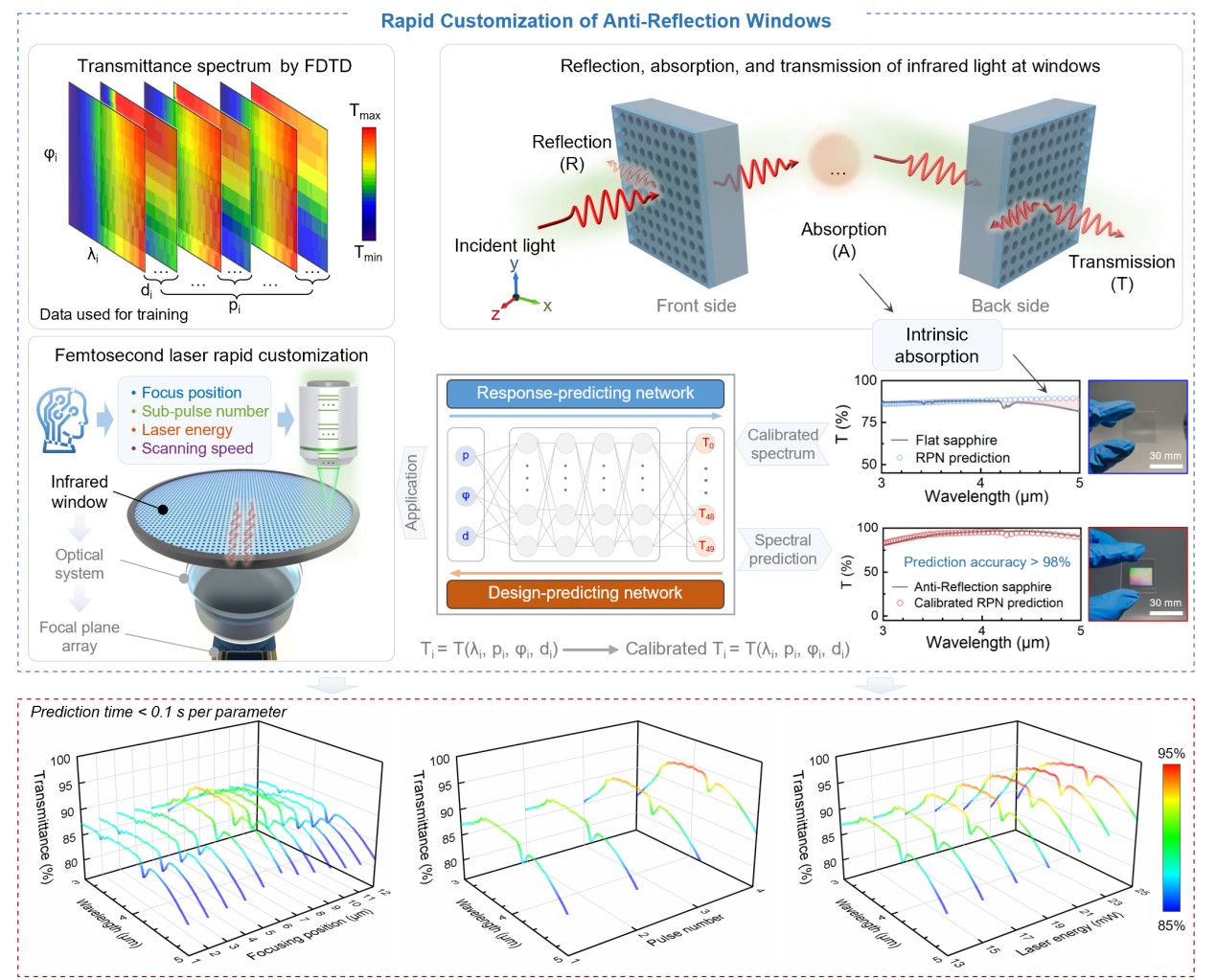
In this study, the team constructed a machine learning model embedded with the material’s absorption characteristics as a physical constraint. This model achieves highly accurate prediction of ultra-broadband transmittance spectra within the material’s intrinsic absorption band (error <2%), successfully overcoming the failure of conventional numerical simulations in these critical spectral regions. By deploying the trained model as an intelligent agent, the team transformed the traditionally costly and time-consuming physical trial-and-error process into an efficient cycle of virtual screening and iteration, enabling millisecond-scale mapping and inverse optimization from multi-dimensional femtosecond laser parameters to final optical performance (Fig. 1).
As a proof-of-concept, the team successfully fabricated a high-performance anti-reflective sapphire window. Experimental results demonstrate exceptional anti-reflective performance across a broad spectral range of 3.3–6.0 μm, with a peak transmittance of ~96.8% at 4.2 μm. The window also exhibits outstanding wide-angle characteristics, mechanical wear resistance, and high-quality imaging capability, highlighting its potential for reliable service in extreme and complex environments (Fig. 2).
This work establishes a novel paradigm of intelligent manufacturing, seamlessly integrating machine learning with femtosecond laser processing. It marks a fundamental shift from experience-driven trial-and-error to data-driven optimization, providing a transformative pathway for the rapid customization of high-performance anti-reflective windows and paving the way for next-generation infrared detection systems, optical imaging devices, and optoelectronic components.
Keywords: femtosecond laser, machine learning, anti-reflection windows, spectra prediction, infrared detection
# # # # # #
The research group, led by Prof. Ji’an Duan at the State Key Laboratory of Precision Manufacturing for Extreme Service Performance, Central South University, focuses on optoelectronic device manufacturing and ultrafast laser micro/nano fabrication. Prof. Duan serves as Dean of the College of Mechanical and Electrical Engineering and holds prestigious titles including Changjiang Scholar Distinguished Professor and National Ten-Thousand Talents Program Leading Innovator. He has led over 10 major national projects and developed submicron-precision coupling packaging equipment widely adopted in industry. Prof. Cong Wang, a nationally recognized high-level young talent and among the World’s Top 2% Scientists, specializes in ultrafast laser micro/nano manufacturing. He has published over 60 SCI papers as first/corresponding author in leading journals such as Opto-Electron. Sci. and Int. J. Extreme Manuf., with multiple ESI highly cited and hot papers. Associate Prof. Xianshi Jia focuses on ultrafast laser-matter interactions, with publications in prestigious journals including Opto-Electron. Sci. and Opto-Electron. Adv.. Together, the team integrates expertise in laser processing, intelligent manufacturing, and optoelectronic packaging to advance high-performance optical component fabrication.
# # # # # #
Opto-Electronic Science (OES) is a peer-reviewed, open access, interdisciplinary and international journal. OES has been indexed in ESCI, Scopus, DOAJ, and CAS databases, with a Scopus CiteScore Tracker of 30.7 for 2025 and a JCR Immediate Impact Factor of 26.
# # # # # #
More information: https://www.oejournal.org/oes
Editorial Board: https://www.oejournal.org/oes/editorialboard/list
All issues available in the online archive (https://www.oejournal.org/oes/archive)
Submission of OES may be made using ScholarOne (https://mc03.manuscriptcentral.com/oes)
CN 51-1800/O4
ISSN 2097-0382
Contact Us: oes@ioe.ac.cn
Twitter: @OptoElectronAdv (https://twitter.com/OptoElectronAdv?lang=en)
WeChat: OE_Journal
# # # # # #
Ding YL, Jiang X, Wang C et al. Femtosecond laser rapid customization of high-performance anti-reflection windows. Opto-Electron Sci 5, 260004 (2026). DOI: 10.29026/oes.2026.260004
Opto-Electronic Science Editorial Office
Opto-Electronic Science
+86 591 2286 1222
email us here
Legal Disclaimer:
EIN Presswire provides this news content “as is” without warranty of any kind. We do not accept any responsibility or liability
for the accuracy, content, images, videos, licenses, completeness, legality, or reliability of the information contained in this
article. If you have any complaints or copyright issues related to this article, kindly contact the author above.

Media gallery